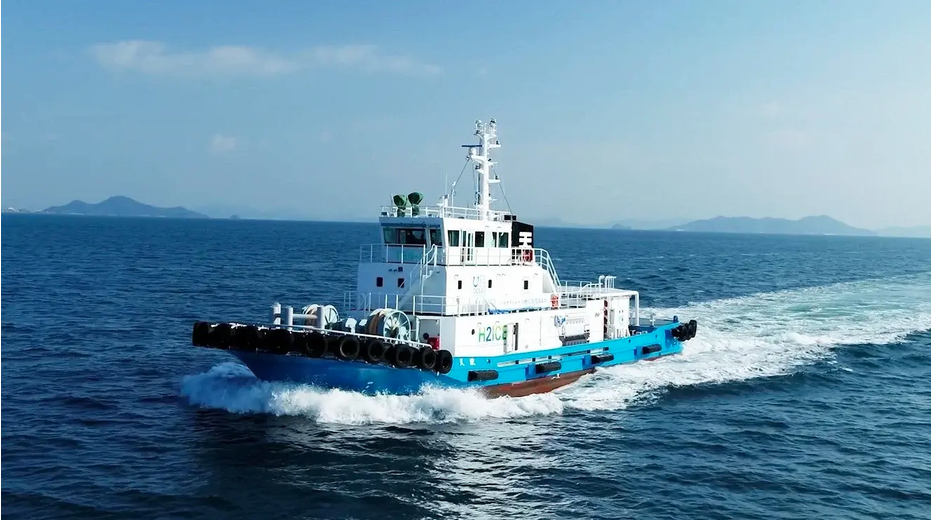
Japan continues to demonstrate its commitment to maritime decarbonisation with substance over hype. The TEN-OH isn’t just another concept vessel—it’s a fully operational, high-power tugboat now entering commercial demonstration. What makes this particularly noteworthy is the technology partnership: Belgian expertise from CMB.TECH combined with Japanese shipbuilding precision. This is exactly the kind of international collaboration the hydrogen transition requires.
Japan’s first hydrogen dual-fuel tugboat, TEN-OH, has begun demonstration operations following its delivery by Tsuneishi Shipbuilding in October 2025. The 38-meter vessel represents a significant milestone in Japan’s Zero Emission Ships Project and marks the second deployment of BeHydro’s hydrogen combustion technology in a commercial tugboat—following the successful Hydrotug 1 at the Port of Antwerp-Bruges.
The vessel is now conducting demonstration voyages and bunkering operations, with trials scheduled to continue through 2026.
Technical Specifications
| Specification | Value |
|---|---|
| Vessel Name | TEN-OH |
| Length Overall | 38.0 m |
| Breadth | 9.6 m |
| Draft | 4.2 m |
| Gross Tonnage | <300 GT |
| Main Engines | Twin BeHydro 12-cylinder hydrogen dual-fuel ICE |
| Power Output | 4,400 hp class (~3.3 MW total) |
| Hydrogen Storage | ~250 kg (high-pressure compressed) |
| Fuel Type | Hydrogen + traditional marine fuels [CH2] |
| CO₂ Reduction | ~60% vs. conventional tugboats |
| Classification | ClassNK |
Why Hydrogen Tugboats Matter
Tugboats are deceptively important vessels for maritime decarbonisation. They operate in ports—areas increasingly under scrutiny for air quality and emissions—and require substantial power for manoeuvring large vessels. A typical harbour tug runs its engines at high loads for extended periods, making them significant emissions sources despite their modest size.
The challenge for hydrogen tugboats is maintaining the high power output and reliability that port operations demand. TEN-OH addresses this directly with its twin 12-cylinder engines delivering 4,400 horsepower—matching conventional tug performance while significantly reducing emissions.
Dual-Fuel Redundancy
A critical design feature: in the event of hydrogen fuel system failure, TEN-OH can continue operating solely on marine fuel. This redundancy maintains the same safety standards as conventional vessels—essential for harbour operations where reliability is non-negotiable.
International Technology Partnership
TEN-OH’s propulsion system comes from JPNH2YDRO, a joint venture between Tsuneishi Group and CMB.TECH. The BeHydro engines are manufactured by a joint venture between Anglo Belgian Corporation (ABC) and CMB.TECH—the same partnership that delivered engines for Hydrotug 1.
Key Technology Partners
- Shipbuilder: Tsuneishi Shipbuilding (Fukuyama, Japan)
- Hydrogen Systems: JPNH2YDRO (Tsuneishi Group + CMB.TECH)
- Engines: BeHydro (ABC + CMB.TECH)
- Classification: ClassNK
- Steel: JGreeX green steel by JFE Steel Corporation
The use of JGreeX green steel throughout the vessel’s construction adds another layer of sustainability—reducing the embodied carbon of the vessel itself, not just operational emissions.
Context: The Growing Hydrogen Tug Fleet
TEN-OH joins a small but growing fleet of hydrogen-powered tugboats worldwide. The most direct comparison is Hydrotug 1, operational at the Port of Antwerp-Bruges since late 2023:
| Specification | TEN-OH (Japan) | Hydrotug 1 (Belgium) |
|---|---|---|
| Length | 38.0 m | 30.2 m |
| Power | ~3.3 MW (4,400 hp) | 4 MW |
| H₂ Storage | ~250 kg | 415 kg |
| Bollard Pull | Not specified | 65 tonnes |
| Engines | BeHydro 12-cyl dual-fuel | BeHydro V12 dual-fuel |
| Emission Reduction | ~60% | ~65% |
Both vessels use the same core BeHydro technology, demonstrating that hydrogen dual-fuel combustion is now proven and scalable across different vessel designs and operating environments.
The Nippon Foundation Zero Emission Ships Project
TEN-OH was developed under the Nippon Foundation’s Zero Emission Ships Project, which aims to achieve carbon neutrality in Japan’s coastal shipping sector by 2050. The project is developing and demonstrating several vessel types:
- TEN-OH: Hydrogen dual-fuel tugboat (delivered October 2025)
- Hanaria: Hydrogen fuel cell + biodiesel passenger vessel (completed certification voyages in 2024)
- Hydrogen tankers and cargo vessels: Planned trials through fiscal 2026
Japanese Hydrogen Leadership
Japan holds more hydrogen patents than any other country. The Zero Emission Ships Project aims to leverage this technical expertise to lead the global shipping industry toward carbon neutrality—exporting not just vessels but complete hydrogen propulsion solutions.
Funding & Policy Support
The project benefits from Japan’s substantial commitment to hydrogen technology through the Green Innovation Fund, a ¥2 trillion (~€12.5 billion) programme managed by NEDO (New Energy and Industrial Technology Development Organization). This fund supports the entire hydrogen value chain for shipping:
- Marine hydrogen engine development (Kawasaki, Yanmar, Japan Engine)
- Liquefied hydrogen fuel supply systems
- Vessel construction and demonstration
- Bunkering infrastructure development
Separately, the Japanese Ministry of the Environment and Ministry of Land, Infrastructure, Transport and Tourism have approved Yanmar’s production plan for hydrogen-fuelled engines and fuel cell systems—signalling regulatory support for scaling production.
⚠️ The Dual-Fuel Question
While TEN-OH’s 60% emission reduction is significant, the dual-fuel approach means it still burns conventional marine fuel alongside hydrogen. Critics note that without consistent access to green hydrogen and operational discipline, such vessels could default to running primarily on diesel.
The demonstration phase will be critical in establishing realistic operational profiles and proving that high hydrogen utilisation rates are achievable in daily port operations.
Project Timeline
- March 2025: TEN-OH launched at Tsuneishi Shipbuilding, Fukuyama
- October 9, 2025: ClassNK classification completed
- October 15, 2025: Delivery to operator
- 2025-2026: Demonstration voyages and bunkering trials
- 2026+: Expected transition to commercial operations
What This Means for the Industry
TEN-OH’s demonstration phase will provide valuable operational data for the broader hydrogen shipping transition. Key questions to watch:
- What hydrogen utilisation rates are achievable in real port operations?
- How does bunkering logistics work for compressed hydrogen in a busy port environment?
- What maintenance and training requirements emerge from commercial operation?
- Can the 60% emission reduction target be consistently achieved?
Tsuneishi Shipbuilding has indicated it will apply the expertise gained from TEN-OH to future vessel projects, including methanol-fuelled and LNG-fuelled ships. The company sees hydrogen as one pathway in a multi-fuel strategy for maritime decarbonisation.
For port operators considering hydrogen tugs, TEN-OH and Hydrotug 1 together demonstrate that the technology works. The remaining questions are about infrastructure, fuel supply, and operational economics—challenges that become clearer only through real-world demonstration.
Related Resources on HydrogenShipbuilding.com
- Ship Projects Database – Track hydrogen vessels worldwide including TEN-OH
- Japan Hydrogen Engine Consortium – NEDO-funded engine development by Kawasaki, Yanmar, and J-ENG
- Hydrogen Supply: Bunkering – Compressed hydrogen bunkering procedures and infrastructure
- Technical Glossary – Key terminology for hydrogen propulsion systems
Sources & References
- Tsuneishi Shipbuilding (October 2025). Official press release: “TSUNEISHI Delivered the Japan’s First Hydrogen Dual-Fuelled Tugboat”
- The Maritime Executive (October 2025). “Japan’s First Hydrogen Dual-Fuel Tugboat Delivered to Begin Demonstrations”
- Offshore Energy (October 2025). “Japan’s first hydrogen dual-fuel tugboat sees the light of day”
- ClassNK (October 2025). Classification announcement for hydrogen-fueled tugboat TEN-OH
- CMB.TECH (December 2023). “Port of Antwerp-Bruges & CMB.TECH launch the Hydrotug 1”
- The Nippon Foundation. Zero Emission Ships Project documentation
- NEDO Green Innovation Fund Projects. Development of Marine Hydrogen Engine and MHFS programme information
Leave a Reply