HydrogenShipbuilding.com

click to database

Tag: LT-PEM

  • ABB and HDF Energy to Develop Megawatt-Scale Fuel Cells for Large Ships

    ABB and HDF Energy to Develop Megawatt-Scale Fuel Cells for Large Ships

    ABB and HDF Energy have signed a joint development agreement to create high-power fuel cell units enabling megawatt-scale hydrogen installations on large seagoing vessels, including container feeder ships and liquefied hydrogen carriers, marking a significant step toward scaling fuel cell technology beyond small vessel applications.

    Timeline and Commercial Viability

    The agreement foresees pilot installations in 2028-2029 and serial production from 2030, representing a major advancement in developing fuel cells as a commercially viable option for maritime decarbonization. The project builds on an earlier Memorandum of Understanding signed between ABB and HDF Energy in 2020.

    Technology Partnership

    The collaboration combines complementary expertise from both companies. France-based HDF will provide the fuel cell technology, while ABB will supply power converters, power management, and electrical and control integration, with the two parties collaborating on specifications, conceptual design, and commercial opportunities. Note that ABB already has relevant experience from an earlier

    The high-power fuel cell unit will enable reducing maritime emissions by facilitating the construction of large hydrogen-electric vessels and allowing diesel auxiliary gensets to be replaced with hydrogen fuel cell units on board existing ships. Where the fuel cells utilize green hydrogen, the decarbonization impact will be particularly significant.

    System Integration

    ABB’s Onboard DC Grid power system will ensure the unit can be integrated seamlessly with other power sources and subsystems such as battery energy storage, where the fuel cells will maximize the operational range and flexibility of the hybrid power system.

    Beyond propulsion applications, the unit has potential to accelerate marine electrification as an auxiliary power source for shore-power and charging infrastructure in ports, supporting peak power demands when grid capacity is limited.

    Scaling Beyond Small Vessels

    While fuel cell systems have been demonstrated on smaller vessels such as tugs, they have yet to see commercial-scale deployment on large ships. This development represents a critical step in scaling the technology to larger vessel applications where power requirements are substantially higher.

    Why This Matters

    This partnership addresses one of the most critical barriers to hydrogen adoption in deep-sea shipping: the lack of megawatt-scale fuel cell systems. While smaller vessels have successfully demonstrated fuel cell technology, larger ships require power outputs that existing marine fuel cells simply cannot deliver. By targeting megawatt-scale installations, ABB and HDF Energy are tackling the power density challenge that has kept fuel cells confined to harbor craft and short-sea applications. The 2028-2029 pilot timeline is aggressive but realistic, giving shipowners planning hydrogen vessels for early-2030s delivery a viable propulsion option. More significantly, the hybrid integration approach—combining fuel cells with ABB’s DC Grid and battery storage—offers operational flexibility that pure fuel cell systems lack, potentially making this the first commercially scalable solution for hydrogen propulsion on container feeders and other medium-to-large vessels.

    Industry Response

    “We at HDF are very excited to combine our fuel cell knowledge with ABB’s marine systems integration expertise to provide a practical means of decarbonizing the maritime industry,” said Hanane El Hamraoui, CEO of HDF Energy.

    “ABB and HDF have been collaborating for several years, making significant progress toward a viable solution for decarbonizing larger vessels,” said Rune Braastad, President of ABB’s Marine & Ports division. “We at ABB remain fully committed to developing technologies that accelerate maritime decarbonization, and this new agreement with HDF reflects another important step forward.”

    Target Applications

    The technology targets several vessel categories that could benefit from megawatt-scale fuel cell power. Container feeder ships operating on regional routes represent an ideal application, as their shorter voyage distances align with current hydrogen storage capabilities while their power requirements demand the megawatt-scale units this partnership aims to deliver.

    Liquefied hydrogen carriers present another logical application, as these vessels would have ready access to their cargo for fuel, though technical challenges around boil-off management and fuel handling would need resolution.

    Hybrid System Advantages

    The integration with ABB’s DC Grid platform enables fuel cells to operate alongside batteries and other power sources, providing operational flexibility that single-fuel systems cannot match. This hybrid approach allows vessels to optimize between fuel cell efficiency during steady-state operations and battery power for peak demands or maneuvering.

    Key system components:

    • Fuel Cells: Megawatt-scale units for primary power generation
    • Power Converters: ABB-supplied systems for electrical integration
    • DC Grid Integration: Seamless operation with other power sources
    • Battery Storage: Support for peak power demands
    • Shore Power Capability: Auxiliary power for port infrastructure

    The system’s potential use as auxiliary power for shore-side infrastructure could accelerate adoption by providing additional revenue streams and use cases beyond vessel propulsion.

    Development Timeline

    The joint development agreement establishes a clear roadmap:

    • 2025-2027: Design and engineering phase
    • 2028-2029: Pilot installations on test vessels
    • 2030 onwards: Serial production and commercial deployment

    This timeline positions the technology to support the wave of hydrogen vessel orders expected in the late 2020s as shipping companies work to meet IMO 2050 decarbonization targets.


    Sources

    • ABB Press Release (December 15, 2025)
    • The Maritime Executive

  • Norway supports liquid hydrogen fleet

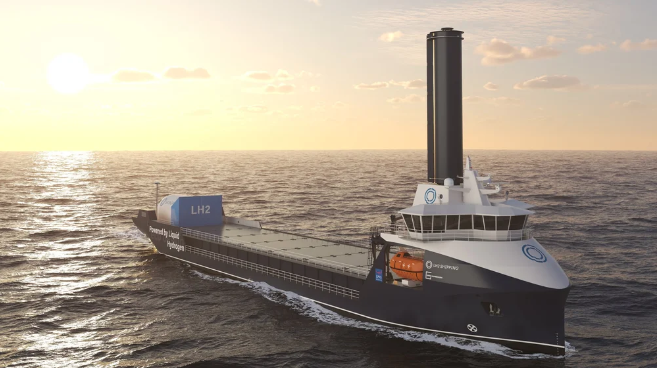
    Norway’s state-owned Enova has awarded substantial funding for six hydrogen-powered bulk carriers, marking a significant acceleration in the deployment of zero-emission maritime technology. The latest round brings the total number of liquid hydrogen bulk carriers to four, demonstrating growing confidence in hydrogen as a viable marine fuel.

    Expanding the Liquid Hydrogen Fleet

    LH2 Shipping, in partnership with Strand Shipping Bergen (part of the Vertom Group), received approximately $29 million in additional funding from Enova to construct two more liquid hydrogen-powered bulk carriers. This award follows an earlier grant of $23.5 million secured in the spring for the first two vessels, bringing the total number of hydrogen-powered ships in the project to four.

    Source: LH2 Shipping

    The expanded funding represents more than NOK 536 million ($52.5 million) in total state support for this single project—a clear signal of Norway’s commitment to maritime decarbonization.

    Technical Specifications

    The four vessels, branded under the “NordBulk” project, will be 7,700 dwt bulk carriers designed for short sea shipping. Each 108-meter (353-foot) vessel will transport bulk and general cargo between northern Norway, the Baltic region, and mainland Europe.

    Key technical features:

    • LH₂ Storage: 17 tonnes liquid hydrogen capacity per vessel
    • Power Generation: 3.5 MW PEM fuel cells
    • Battery Support: 1.5 MWh battery pack to support fuel cell operation
    • Shore Power: Equipped for shore power connection during loading/unloading
    • Backup System: Standby diesel/biodiesel generator for operational redundancy

    The onboard hydrogen systems consist of C-type vacuum-insulated tanks storing liquid hydrogen at -253°C. This proven technology builds directly on the experience gained from Norled’s MF Hydra ferry, which has been operating successfully on liquid hydrogen since 2023.

    Coastal Hydrogen Operations

    In addition to the liquid hydrogen bulk carriers, GMI Rederi received funding to construct two coastal bulk carriers powered by compressed hydrogen. These vessels will combine multiple zero-emission technologies:

    • Fuel cells running on compressed hydrogen
    • Battery energy storage systems
    • Wind-assisted propulsion technology

    The ships will operate along the Norwegian coast, transporting asphalt and construction materials—applications where the shorter range and established coastal infrastructure make compressed hydrogen a practical choice.

    Building the Supply Chain

    A critical component of these projects is the parallel development of hydrogen production and bunkering infrastructure. In November 2024, Enova awarded over NOK 777 million ($70.9 million) to five hydrogen production projects along the Norwegian coast, from Slagentangen in the southeast to Bodø in the north.

    These production facilities will provide:

    • Total capacity: 120 MW
    • Daily production: Approximately 40 tons of hydrogen
    • Coverage: Strategic locations along major shipping routes

    Nils Kristian Nakstad, CEO of Enova, stated: “The projects that receive support will be part of a network of hydrogen producers along the Norwegian coastline. This will make hydrogen more accessible to those who want to invest in sustainable shipping.”

    The Economics of Hydrogen Shipping

    The business case for hydrogen vessels is improving rapidly due to several factors:

    Regulatory Drivers:

    • EU Emissions Trading System (ETS) now includes maritime transport
    • FuelEU Maritime regulations mandate gradual emissions reductions
    • IMO’s 2050 net-zero target creates long-term regulatory certainty

    Cost Competitiveness:
    With carbon pricing mechanisms in place, the cost gap between fossil fuels and hydrogen is narrowing. After 2030, when CO₂ emission fees increase further under EU regulations, zero-emission vessels are expected to achieve operational cost parity with conventional ships on many routes.

    The Enova grants cover up to 80% of the additional costs associated with hydrogen technology—a significant increase from the previous 40% support level. This enhanced support reflects Norway’s strategic goal to establish first-mover advantage in zero-emission shipping technologies.

    Environmental Impact

    The six hydrogen-powered bulk carriers receiving funding in this round will collectively contribute to:

    • Annual CO₂ reduction: Significant emissions cuts in short-sea shipping
    • Zero local emissions: No NOx, SOx, or particulate matter during fuel cell operation
    • Scalable model: Demonstration of commercially viable hydrogen operations

    Enova emphasizes that supporting these pioneer vessels creates the foundation for broader adoption. As Andreas Bjelland Eriksen, Norway’s Minister for Climate and Environment, stated: “Norway must be at the forefront of the transition at sea.”

    Timeline and Next Steps

    The vessels are expected to enter service between 2026 and 2029, with construction beginning in 2025. Shipyard selection is underway, with Norwegian and European yards competing for the contracts.

    Enova has announced it will continue its support programs, with additional funding rounds planned for 2025 and 2026. The organization reports receiving 31 applications in the latest round, indicating strong industry interest in hydrogen and ammonia propulsion.

    Industry Significance

    This latest funding announcement positions Norway as the clear leader in hydrogen shipping deployment. The country’s comprehensive approach—supporting vessels, production facilities, and infrastructure simultaneously—creates the conditions for a functioning hydrogen maritime ecosystem.

    For the global shipping industry, Norway’s hydrogen program provides crucial real-world data on:

    • Operational costs of hydrogen vs. conventional fuel
    • Reliability of liquid vs. compressed hydrogen systems
    • Integration challenges in existing shipping operations
    • Bunkering procedures and infrastructure requirements

    As the maritime industry faces increasing pressure to decarbonize, Norway’s hydrogen pioneers are demonstrating that zero-emission bulk shipping is not just technically feasible—it’s becoming economically viable.

    Looking Ahead

    With four liquid hydrogen bulk carriers and two compressed hydrogen coastal vessels now funded and under development, Norway is creating a critical mass of hydrogen shipping operations. When these vessels enter service, they will provide the operational experience needed to scale hydrogen technology across larger ships and longer routes.

    The success of these projects will be closely watched by shipowners worldwide, particularly in Europe where emissions regulations are tightening rapidly. If the NordBulk vessels demonstrate reliable, cost-competitive operations, they may catalyze a broader shift toward hydrogen in the short-sea shipping segment.


    This article is based on reports from Maritime Executive, Ship & Bunker, Clean Shipping International, Norwegian Hydrogen, Hellenic Shipping News, and official Enova communications.

  • South Korea Charts New Course with Launch of First Hydrogen Fuel-Cell Vessel

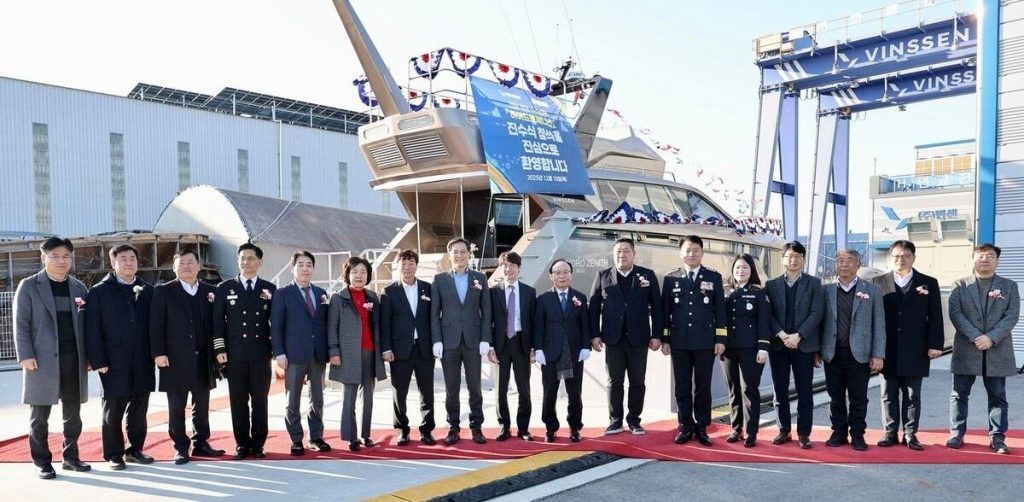
    December 18, 2024 marked a watershed moment for maritime decarbonization as VINSSEN, a South Korean clean technology firm, launched the Hydro Zenith — the nation’s first hydrogen fuel-cell powered vessel built in full compliance with official safety standards.

    Source: Vinssen

    The launch ceremony at VINSSEN’s Yeongam facility drew over 100 attendees, including government officials from Jeollanam-do Province and Yeongam County, industry partners, and research institutions. This milestone represents more than just a technological achievement; it signals South Korea’s serious commitment to transforming its maritime sector toward zero-emission operations.

    A Vessel Built on New Standards

    What sets Hydro Zenith apart is its development under the Ministry of Oceans and Fisheries’ Interim Standards, established in 2023 specifically for hydrogen fuel-cell propulsion vessels. These regulations provide a clear framework for design, equipment configuration, and inspection procedures, enabling hydrogen-powered ships to be built and certified within existing ship safety laws.

    The leisure vessel showcases impressive technical specifications. Its hybrid propulsion system combines two 100 kW hydrogen fuel cells with four 92 kWh battery packs, delivering speeds up to 20 knots (approximately 37 km/h) while producing zero emissions. The hydrogen fuel cell technology operates by creating an electrochemical reaction between hydrogen and oxygen at the anode and cathode, generating direct current electricity along with only heat and water as byproducts.

    Smart Technology Meets Clean Energy

    Beyond its clean propulsion system, Hydro Zenith integrates sophisticated digital monitoring capabilities that track vessel performance and energy consumption in real-time. This data-driven approach enables predictive maintenance and optimized operations — essential features as the maritime industry transitions toward digital management systems.

    The vessel’s hydrogen fuel cell system has undergone rigorous safety verification through pre-certification by the Korea Marine Traffic Safety Authority (KOMSA), demonstrating that it can be deployed without requiring regulatory exemptions. This achievement is particularly significant as it proves hydrogen technology can meet stringent maritime safety requirements.

    Public-Private Collaboration at Work

    The Hydro Zenith project exemplifies effective public-private partnership, with joint funding from Jeollanam-do Province, Yeongam County, and VINSSEN, supported by leading Korean research institutions including JNTP, KOMERI, and KITECH. Each partner brought specialized expertise: technical and regulatory support, hull stability assessment, fuel cell system performance evaluation, and advanced welding technology.

    VINSSEN CEO Chil Han Lee emphasized the project’s broader significance, noting it represents an essential step toward achieving carbon neutrality and improving Korea’s maritime environment. The company, which holds over 50 patents related to electric propulsion and hydrogen fuel cell systems, aims to convert diesel-powered vessels into eco-friendly alternatives.

    The Path Forward: Sea Trials and Beyond

    With the launch complete, Hydro Zenith will now undergo comprehensive real-sea trials to validate hydrogen vessel safety standards and demonstrate operational viability. These trials will provide critical data to accelerate the commercialization of zero-emission marine mobility solutions.

    VINSSEN isn’t stopping here. The company recently showcased its 100 kW and 250 kW marine hydrogen fuel cell systems, both currently undergoing type approval processes. In March 2025, VINSSEN also secured Approval in Principle from Korean Register for what would be South Korea’s first hydrogen fuel-cell powered tugboat, featuring a robust 2,700 kW system.

    The company has already received international recognition as well, including Type Approval from Italian classification society RINA for its 60 kW maritime fuel cell stack, and project-based approval from Bureau Veritas for trials conducted in Singapore with partners including Shell, Seatrium Limited, and Air Liquide.

    Korea’s Hydrogen Maritime Vision

    The Hydro Zenith launch fits into South Korea’s ambitious national hydrogen strategy. The country has positioned itself as a global hydrogen frontrunner, with Hyundai Motor launching the world’s first commercial fuel cell electric vehicle back in 2013. The government’s Hydrogen Economy Roadmap sets aggressive targets: producing 6.2 million fuel cell electric vehicles by 2040 and establishing 15 gigawatts of fuel cell power generation capacity.

    While fuel cell systems have been demonstrated on smaller vessels for shorter routes, commercial-scale deployment on large ships remains an ongoing challenge. However, projects like Hydro Zenith provide essential proof-of-concept and regulatory frameworks that could pave the way for broader adoption.

    The Bigger Picture

    As the maritime industry faces mounting pressure to reduce its carbon footprint, hydrogen fuel cells offer a promising pathway forward. Unlike battery-electric systems limited by weight and range constraints, hydrogen can provide the energy density needed for longer voyages while producing zero emissions at the point of use.

    The success of Hydro Zenith demonstrates that hydrogen marine technology is moving from experimental concept to regulatory-compliant reality. With proper safety frameworks, technological innovation, and collaborative partnerships, hydrogen-powered vessels could become a significant part of the maritime decarbonization puzzle.

    VINSSEN’s achievement also highlights South Korea’s strategic approach to building a complete hydrogen ecosystem — from production facilities and refueling infrastructure to end-use applications across automotive, industrial, and now maritime sectors.

    As Hydro Zenith prepares for its sea trials in 2025, the maritime industry will be watching closely. The data and operational experience gained from this pioneering vessel could help chart the course for hydrogen’s role in achieving the sector’s ambitious climate goals.


    The Hydro Zenith represents not just a technological milestone, but a tangible step toward reimagining marine transportation for a zero-emission future. As countries worldwide seek pathways to maritime decarbonization, South Korea’s integrated approach — combining regulatory frameworks, public-private partnerships, and technological innovation — offers valuable lessons for the global shipping industry.

  • Yanmar’s Hydrogen Fuel Cell System Earns DNV Approval

    Another milestone in fuel cell development for maritime, after reporting on earlier developments. This time for a very well known Japanese brand in propulsion: Yanmar. If they can apply the same rigor in their fuel cell offering as their engines this is a very promising development. Finally ship owners can choose fuel cells from a well-known maritime supplier.

    Pioneering Sustainable Maritime Solutions

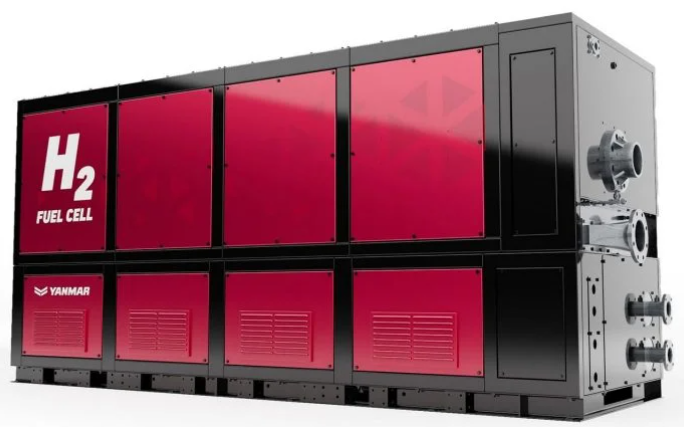
    Yanmar Power Technology has achieved a significant milestone. Their GH320FC Maritime Hydrogen Fuel Cell System received Approval in Principle (AiP) from DNV, a leading classification society.

    Source: Yanmar

    Modular design

    The GH320FC is designed for easy installation across various vessels. Its modular design allows multiple units to connect in parallel, meeting diverse power needs. This flexibility makes it ideal for coastal ferries, inland cargo ships, and port service vessels, especially in Europe’s low-emission zones.

    The power output is 300 kW which bring the fuel cell into the larger segment, which is required for shipping’s multi-megawatt.

    European decarbonization

    Eric Tigelaar, Yanmar Europe’s Commercial Marine Department Manager, emphasized the system’s role in providing sustainable energy solutions. Masaru Hirose, General Manager at Yanmar Power Technology, highlighted its contribution to European decarbonization goals, building on successful deployments in Japan.

    DNV’s Olaf Drews praised the system’s potential in achieving zero-emission operations. He noted that fuel cells with renewable fuels offer efficient, scalable power solutions for the maritime industry’s future.

    This approval marks a pivotal step toward cleaner maritime operations. Yanmar’s innovation aligns with global efforts to reduce emissions and promote sustainable energy in marine transport.

  • Viking Libra: A step Towards Zero-Emission Cruising

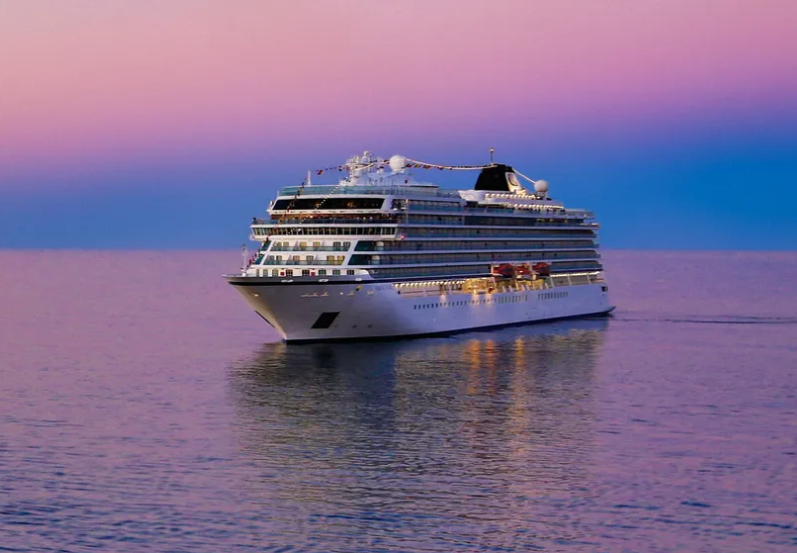
    In a groundbreaking development for the maritime industry, Italian shipbuilder Fincantieri and Swiss cruise line Viking have unveiled the world’s first cruise ship powered by liquid hydrogen stored onboard. This pioneering vessel, named Viking Libra, is currently under construction at Fincantieri’s Ancona shipyard, with delivery anticipated in late 2026. This has been long in the making but very good to see this public announcement. It is another confirmation of the role liquid hydrogen can play in maritime transport.

    Source: Viking cruises

    The Viking Libra represents a significant advancement in sustainable maritime technology. With a gross tonnage of approximately 54,300 tons and a length of 239 meters, the ship is engineered to operate with zero emissions. Its state-of-the-art hydrogen propulsion system, combined with advanced fuel cell technology, is capable of generating up to 6 megawatts of power.

    A notable feature of the Viking Libra is its innovative approach to hydrogen storage and utilization. The vessel will incorporate a containerized system designed to load and store hydrogen directly onboard, effectively addressing existing supply chain challenges. This hydrogen will fuel a polymer electrolyte membrane (PEM) fuel cell system, specifically optimized for cruise operations and developed by Isotta Fraschini Motori (IFM), a subsidiary of Fincantieri specializing in advanced fuel cell technology.

    Torstein Hagen, Chairman and CEO of Viking, expressed pride in this environmental milestone:

    “From the outset, we have designed our river and ocean ships thoughtfully to reduce their fuel consumption, and we are very proud that the Viking Libra and the Viking Astrea will be even more environmentally friendly. Viking made the principled decision to invest in hydrogen, which offers a true zero-emission solution. We look forward to welcoming the world’s first hydrogen-powered cruise ship to our fleet in 2026.”

    Expanding the Fincantieri-Viking Partnership

    In addition to the Viking Libra, Fincantieri is constructing the Viking Astrea, another hydrogen-powered vessel scheduled for delivery in 2027. This initiative underscores Viking’s commitment to sustainable cruising and marks a significant step toward reducing the environmental impact of maritime travel.

    Further strengthening their collaboration, Fincantieri and Viking have signed an agreement for the construction of two additional cruise ships, set for delivery in 2031. This contract includes an option for two more vessels and is based on the successful design features of previous units built by Fincantieri for Viking. These new ships will comply with the latest environmental regulations and incorporate modern safety systems. Positioned in the small cruise ship segment, each will have a gross tonnage of about 54,300 tons and accommodate 998 passengers across 499 cabins.

    Pierroberto Folgiero, CEO and Managing Director of Fincantieri, highlighted the significance of this partnership:

    “With the Viking Libra, we are not only delivering the world’s first cruise ship powered by hydrogen stored on board, but we are also reinforcing our commitment to shaping the future of sustainable maritime transportation. Furthermore, we are thrilled about Viking’s decision to expand its fleet with the order of two additional ships, which reaffirms the strength of our partnership and the trust placed in our expertise.”

    Pioneering Sustainable Maritime Transportation

    The launch of the Viking Libra signifies a pivotal moment in the cruise industry’s journey toward sustainability. By integrating hydrogen fuel technology, Viking and Fincantieri are setting new standards for eco-friendly maritime operations, paving the way for a future where zero-emission cruising becomes the norm.

    As the maritime sector continues to seek innovative solutions to reduce its environmental footprint, collaborations like that of Fincantieri and Viking exemplify the transformative potential of embracing green technologies. The Viking Libra and its sister ships stand as beacons of progress, heralding a new era in sustainable sea travel.

  • Sydrogen Achieves Key Certification for Maritime Fuel Cell

    Another maritime fuel cell supplier achieves Approval in Principle as a first step toward commercialization for maritime applications. The recent flurry of announcements regarding fuel cell approvals is a good sign. More competition is required in this space.

    A Milestone for Maritime Decarbonization

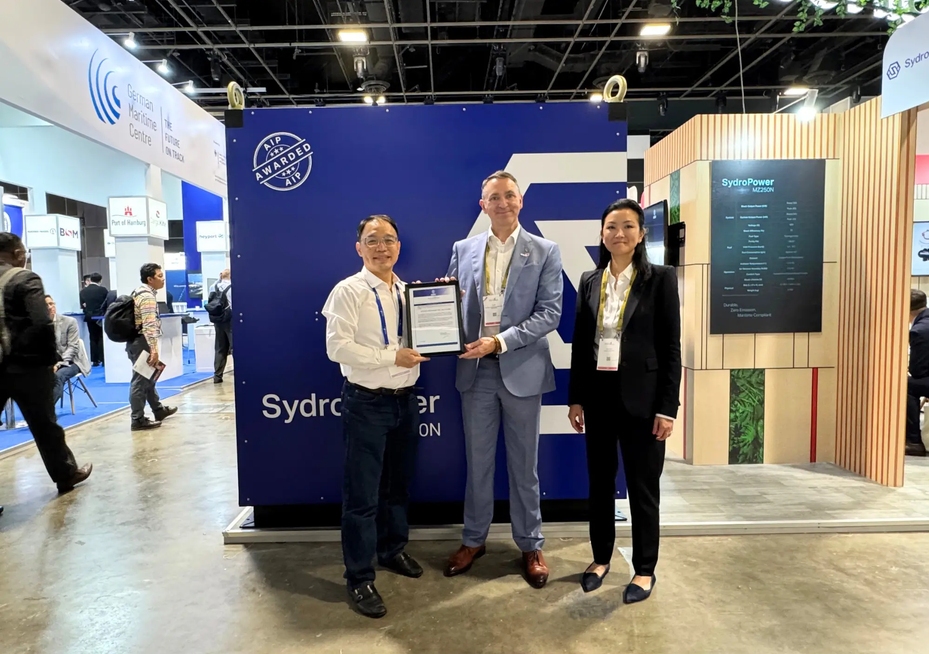
    Singapore-based innovator Sydrogen Energy has achieved a significant breakthrough, securing crucial certification milestones for its maritime hydrogen fuel cell technology. Sydrogen’s Maritime Fuel Cell, the SydroPOWER MZ250N, recently received a Basic Design Assessment (BDA) Statement and Approval in Principle (AiP)from Bureau Veritas Marine & Offshore (BV). The statements mark a vital step toward commercializing advanced hydrogen-based energy solutions in maritime operations.

    Source: Sydrogen

    Advanced Fuel Cell Technology

    The SydroPOWER MZ250N incorporates proven automotive hydrogen fuel cell technology from Sydrogen’s partner, Shanghai Hydrogen Propulsion Technology (SHPT). Designed specifically for maritime environments, this fuel cell system promises reliable and efficient power for various applications, including commercial vessels and offshore platforms. The system significantly reduces greenhouse gas emissions and pollutants, contributing directly to global climate goals and cleaner oceans.

    Rigorous Certification and Validation

    The BDA Statement from Bureau Veritas confirms that the SydroPOWER MZ250N meets stringent safety, performance, and reliability standards. This rigorous evaluation process reinforces Sydrogen’s commitment to excellence and highlights the reliability of their technology. This certification demonstrates the industry’s increasing acceptance and readiness for hydrogen-based maritime solutions.

    Industry Leaders Voice Support

    Teo Eng Dih, Chief Executive of the Maritime and Port Authority of Singapore, praised Sydrogen’s milestone, stating, “We welcome the efforts by Sydrogen and its partners in advancing hydrogen fuel cell technology for maritime use. The Basic Design Assessment is an encouraging milestone that reflects momentum across the industry to explore cleaner energy solutions.”

    Gian Yi-Hsen, CEO of Sydrogen, emphasized the impact of this achievement, noting, “Receiving this Basic Design Assessment Statement from Bureau Veritas marks a transformative moment for Sydrogen Energy. This achievement is not just a validation of our technology’s safety and reliability; it represents a significant step forward in our mission to revolutionize maritime energy solutions.”

    Moving Forward with Sustainable Maritime Energy

    With the certification milestone achieved, Sydrogen is now positioned to accelerate deployment of the SydroPOWER MZ250N. The company is actively engaging with potential customers and industry partners to launch pilot projects and commercial installations. These efforts will help drive maritime operations toward a sustainable, zero-emission future.

    This certification highlights not only Sydrogen’s innovative approach but also underscores the broader maritime industry’s commitment to sustainable and environmentally friendly solutions.

  • Comparing LT-PEM Hydrogen Fuel Cells for Maritime Use

    Over the last months several fuel cells have reached approval milestones from classification societies. This is very encouraging to see as this clear a large hurdle to maritime applications. This article compares the LT-PEM fuel cells currently available for maritime use.

    LT-PEM fuel cells

    Hydrogen fuel cells are becoming the go-to technology for zero-emission maritime propulsion. Among these, low-temperature proton exchange membrane (LT-PEM) fuel cells are particularly suited to shipping. They’re compact, modular, and efficient.

    Below table gives an overview of the relevant fuel cells for maritime applications.

    ManufacturerModelRated PowerDimensions (L×W×H)Inlet Hydrogen PressureClass ApprovalCommercial Use StatusNotable Projects
    Ballard Power (Canada)FCwave™200 kW (modular)1209×741×2195 mm3.5–6.5 bar(g)DNV, LR, ABS (Type Approval)In operationNorled MF Hydra, H₂ Barge 2, Zulu06
    Vinssen (S. Korea)60 kW Stack (120 kW system)60 kW per stack (120 kW system)Compact (N/A)Low-pressure (N/A)RINA (Type Approval)Approved, demo ongoingVinssen demo vessel, KR AiP tug
    Hanwha Aerospace (S. Korea)200 kW Marine PEMFC200 kWN/A (prototype)5–7 bar (expected)DNV/KR (AiP)AiP granted, not yet deployedIntegration with Hanwha Ocean
    TECO 2030 (Norway)FCM400400 kW per moduleContainerized (N/A)5–8 barDNV (AiP)AiP grantedHyEkoTank, ZEAS projects
    PowerCell SwedenMarine System 225225 kW1200×900×2000 mm3–8 bar(g)DNV/LR compliance (pending Type Approval)Deliveries underwayItalian shipbuilder, cruise ships
    Nedstack PemGen 300 (Netherlands)PemGen® 300~825 kW (3×275 kW)Installed in vessel hold (N/A)0.3–6 bar(g)Lloyd’s RegisterIn operationH₂ Barge 1 (Rotterdam-Antwerp)
    Nedstack PemGen 600 (Netherlands)PemGen® 600600 kW (740 kW peak)6060×2440×2900 mm (20′ container)0.3–6 bar(g)BV (AiP)AiP grantedAvailable for inland/coastal vessels
    Cummins/Hydrogenics (USA)Hydrogenics HD360 kW totalInstalled onboard (N/A)Regulated from 350 barUS Coast Guard approvedIn operationSea Change ferry (California)
    EODev (France)REXH₂®70 kW per module1710×1060×1020 mm5–7 bar(g)BV (Type Approval)Type Approved, deployments upcomingPROMETEO catamaran, Energy Observer
    Corvus Energy (Norway)Pelican Fuel Cell340 kW (4×85 kW)2160×1427×2320 mm5.4–14 bar(g)DNV (Type Approval)Type Approved, prototype phaseShort-sea vessels, ferries (planned)
    EH-Group (Swiss)EH TRACE-M250250 kWCompact (N/A)Low-pressure (N/A)DNV (AiP)AiP grantedMaritime applications
    Genevos (France)HPM-250250 kW1400×800×1800 mm>2.5 bar(a)BV (AiP)AiP grantedNordics ferry project, workboats

    Let’s take a closer look at some of the leading LT-PEM hydrogen fuel cell solutions available for maritime applications.

    Proven and In-Service Solutions

    Several manufacturers already have fuel cells operating commercially at sea.

    Ballard Power Systems leads with its FCwave™, a 200 kW module scalable to megawatt levels. The FCwave™ received type approval from DNV, Lloyd’s Register, and ABS. It’s in active use aboard vessels like the Norled MF Hydra, the world’s first liquid hydrogen ferry. Other deployments include H₂ Barge 2 and the Zulu06 inland vessel.

    Nedstack from the Netherlands offers the PemGen® 300, delivering around 825 kW through multiple stacks. It powers the H₂ Barge 1, an inland container vessel servicing Rotterdam and Antwerp since 2023. Nedstack’s modular approach provides flexibility for retrofitting existing vessels. After running in financial difficulties in 2024 Nedstack was taken over by German Freudenberg.

    Cummins (Hydrogenics), with its 360 kW system, powers the Sea Change ferry in California. The system secured approval from the U.S. Coast Guard, highlighting its reliability for passenger transport.

    Fuel Cells with Type Approvals

    Other fuel cell systems have gained recent class approvals, signaling readiness for commercial deployment.

    South Korea’s Vinssen earned RINA type approval in 2025 for its 60 kW stacks (assembled into 120 kW systems). Vinssen’s systems are ideal for smaller vessels, harbor tugs, and ferries. A demonstration vessel is already underway.

    Norway’s Corvus Energy developed the 340 kW Pelican fuel cell pack, based on Toyota modules. It achieved DNV type approval in 2024. Corvus targets short-sea shipping and ferries, promising rapid adoption in Northern Europe.

    France’s EODev secured Bureau Veritas type approval for its modular 70 kW REXH₂® unit. The system’s first marine installation is set for the PROMETEO catamaran, emphasizing flexibility and scalability.

    Systems Nearing Commercial Deployment

    Other players hold Approval in Principle (AiP) from classification societies, signaling they’re close to commercial rollout.

    Hanwha Aerospace from South Korea holds AiP from DNV and Korean Register for its 200 kW marine PEMFC. Hanwha targets larger commercial vessels and integration with ammonia-to-hydrogen solutions.

    TECO 2030 of Norway has DNV AiP for its powerful 400 kW FCM400 module. Unfortunately current status of this development is unclear due to the filing for bankruptcy of the company.

    PowerCell Sweden developed the Marine System 225, optimized at 225 kW per module. Already selected for cruise ships and commercial orders, full type approval is expected soon.

    Genevos from France has an AiP for its compact 250 kW HPM-250. Its modular design suits smaller workboats, ferries, and offshore vessels.

    EH-Group from Swiss has an AiP from DNV for the 250 kW EH-Trace-M250 unit since 2024. The unit has a high power density which makes it well-suited for multi-MW applications.

    Why It Matters

    LT-PEM fuel cells are a critical piece of maritime decarbonization. With type approvals and commercial projects expanding, these systems offer proven, certified solutions. Shipowners can now confidently adopt hydrogen propulsion technology.

    In the coming years, expect rapid growth in zero-emission maritime vessels. LT-PEM fuel cells are leading this charge, delivering reliable, scalable, and emission-free energy at sea.

  • Hydrogen as Marine Fuel: Progress and Challenges

    One challenge of working on hydrogen as marine fuel is that while the technology is ready and successfully applied on board, while regulations are not there yet. The new DNV white paper outlines these issues and provides a roadmap for approval and implementation. The report is recommended reading. Here is a summary.

    Current Status of Hydrogen as Ship Fuel

    • Hydrogen is already used in many industries, but its maritime application is still developing.
    • The first hydrogen-powered vessels, such as the MF Hydra ferry and Project 821, have entered service.
    • Most hydrogen ships today are small or experimental. Larger deep-sea vessels face storage and safety hurdles.

    Safety Challenges

    • Hydrogen is highly flammable, prone to leakage, and has a wide explosive range.
    • Cryogenic storage (-253°C) requires advanced insulation to prevent boil-off and structural embrittlement.
    • High-pressure hydrogen tanks pose additional risks, including spontaneous ignition during leaks.

    Regulatory Landscape

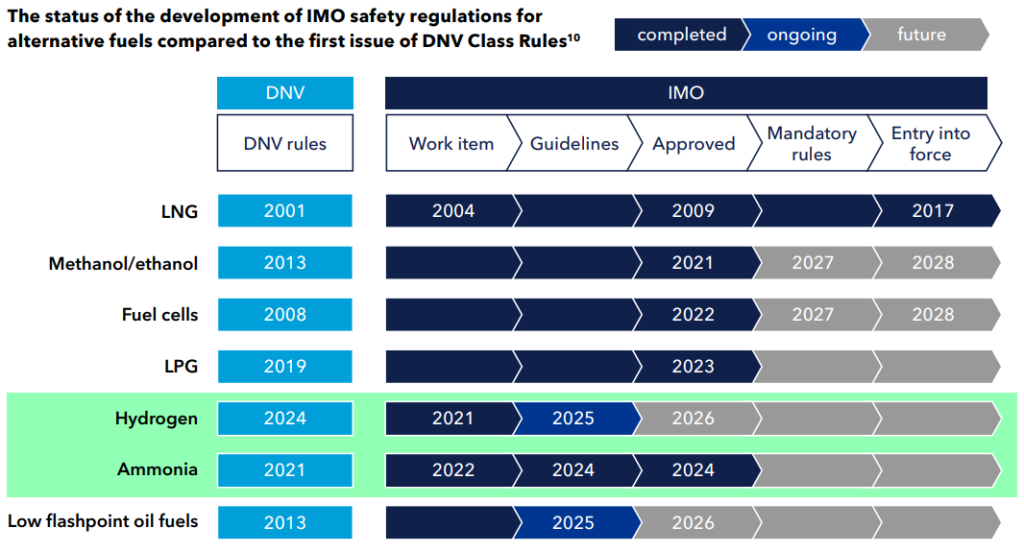
    No detailed IMO regulations currently exist for hydrogen-fueled ships.

    The IGF Code only includes prescriptive rules for natural gas.

    The IMO aims to develop hydrogen-specific regulations by 2028.

    Until then, hydrogen-fueled ships require approval through the Alternative Design Approval (ADA) process.

    Source: DNV

    Timeline for Hydrogen Fuel Adoption

    1. 2021 – IMO starts developing hydrogen safety guidelines.
    2. 2023 – First commercial hydrogen ferry (MF Hydra) enters service.
    3. 2024 – DNV publishes hydrogen ship classification rules.
    4. 2025 – Further regulatory advancements expected.
    5. 2028 – Earliest possible adoption of mandatory IMO hydrogen fuel regulations.

    Ship Design Considerations

    • Hydrogen requires more space than conventional fuels, impacting ship layout.
    • Safe integration includes double-walled pipes, specialized ventilation, and explosion-proof compartments.
    • Fuel cells are preferred for efficiency and safety, but hydrogen combustion engines are under development.

    Future Outlook

    • The transition to hydrogen-fueled ships depends on regulatory support and technological advancements.
    • Collaboration among shipowners, designers, regulators, and fuel suppliers is essential.
    • The industry must develop bunkering infrastructure and crew training to ensure safe operations.

    Key Diagram

    The development spiral shows the path from introducing hydrogen as a new marine fuel to widespread adoption. This requires iterative improvements in technology, regulation, and ship design.

    These advancements position hydrogen as a key player in the future of sustainable shipping. The transition is complex, but with innovation and regulatory backing, hydrogen can lead the industry toward zero emissions.