Bureau Veritas has granted Approval in Principle (AIP) certification to CSSC Jiangnan Shipyard for a 20,000 m³ liquid hydrogen carrier designed for long-distance green hydrogen transport between East Asia, the Middle East, and Australia.
Hydrogen Carrier Design Certified
The vessel features Jiangnan Shipyard’s proprietary ultra-low-temperature cargo containment system, enabling safe hydrogen transport while significantly reducing boil-off rate. The AIP certification validates the technical feasibility and safety of the design, paving the way for construction of what would be one of the world’s largest liquid hydrogen carriers.
Long-distance hydrogen shipping requires maintaining cargo at -253°C throughout voyages potentially spanning thousands of nautical miles. The reduced boil-off rate is critical for commercial viability, as hydrogen loss during transport directly impacts the economics of international green hydrogen trade.
Supporting Infrastructure Development
The certified design targets emerging hydrogen export routes from Australia and the Middle East—regions developing large-scale green hydrogen production capacity—to energy-importing nations in East Asia. This aligns with Japan and South Korea’s strategies to import significant volumes of hydrogen as part of their decarbonization pathways.
Why This Matters
AIP certification for a 20,000 m³ hydrogen carrier marks a critical step toward establishing international hydrogen shipping routes. While smaller demonstration vessels have proven the concept, commercial-scale hydrogen trade requires purpose-built carriers with capacities sufficient to make long-distance transport economically viable. The vessel’s focus on East Asia-Middle East-Australia routes directly addresses the anticipated major hydrogen trade corridors of the 2030s, where resource-rich exporters will supply demand centers lacking domestic renewable energy capacity. Bureau Veritas’s independent technical validation reduces investment risk for shipowners and charterers planning to participate in the emerging hydrogen shipping market.
Additional Green Ship Certifications
Bureau Veritas also granted AIP certification to three other Jiangnan Shipyard projects supporting maritime decarbonization:
200,000 m³ ULAC-FSRU: Ultra-large ammonia carrier with regasification capability for direct pipeline supply
175,000 m³ MARK III Flex LNG Carrier: Optimized design reducing carbon emissions and methane slip
JINAGAS Ammonia Fuel Supply System: Zero-carbon fuel solution compliant with IMO interim guidelines for ammonia as fuel
The certifications strengthen cooperation between Bureau Veritas and Jiangnan Shipyard, supporting practical deployment of green shipping technologies across multiple alternative fuel pathways.
Source: Bureau Veritas Marine & Offshore – “BV Grants AIP Certification to Four Jiangnan Shipyard Projects” (December 29, 2025)
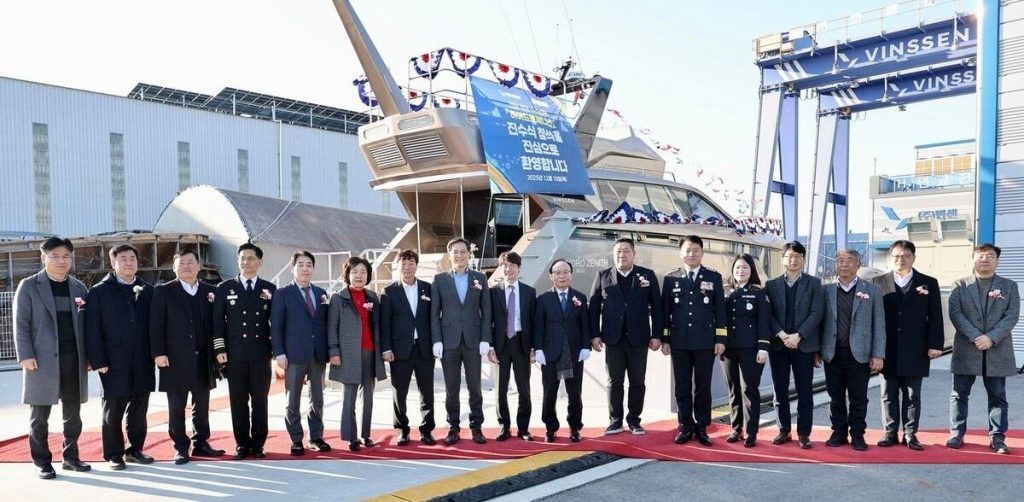
December 18, 2024 marked a watershed moment for maritime decarbonization as VINSSEN, a South Korean clean technology firm, launched the Hydro Zenith — the nation’s first hydrogen fuel-cell powered vessel built in full compliance with official safety standards.
Source: Vinssen
The launch ceremony at VINSSEN’s Yeongam facility drew over 100 attendees, including government officials from Jeollanam-do Province and Yeongam County, industry partners, and research institutions. This milestone represents more than just a technological achievement; it signals South Korea’s serious commitment to transforming its maritime sector toward zero-emission operations.
A Vessel Built on New Standards
What sets Hydro Zenith apart is its development under the Ministry of Oceans and Fisheries’ Interim Standards, established in 2023 specifically for hydrogen fuel-cell propulsion vessels. These regulations provide a clear framework for design, equipment configuration, and inspection procedures, enabling hydrogen-powered ships to be built and certified within existing ship safety laws.
The leisure vessel showcases impressive technical specifications. Its hybrid propulsion system combines two 100 kW hydrogen fuel cells with four 92 kWh battery packs, delivering speeds up to 20 knots (approximately 37 km/h) while producing zero emissions. The hydrogen fuel cell technology operates by creating an electrochemical reaction between hydrogen and oxygen at the anode and cathode, generating direct current electricity along with only heat and water as byproducts.
Smart Technology Meets Clean Energy
Beyond its clean propulsion system, Hydro Zenith integrates sophisticated digital monitoring capabilities that track vessel performance and energy consumption in real-time. This data-driven approach enables predictive maintenance and optimized operations — essential features as the maritime industry transitions toward digital management systems.
The vessel’s hydrogen fuel cell system has undergone rigorous safety verification through pre-certification by the Korea Marine Traffic Safety Authority (KOMSA), demonstrating that it can be deployed without requiring regulatory exemptions. This achievement is particularly significant as it proves hydrogen technology can meet stringent maritime safety requirements.
Public-Private Collaboration at Work
The Hydro Zenith project exemplifies effective public-private partnership, with joint funding from Jeollanam-do Province, Yeongam County, and VINSSEN, supported by leading Korean research institutions including JNTP, KOMERI, and KITECH. Each partner brought specialized expertise: technical and regulatory support, hull stability assessment, fuel cell system performance evaluation, and advanced welding technology.
VINSSEN CEO Chil Han Lee emphasized the project’s broader significance, noting it represents an essential step toward achieving carbon neutrality and improving Korea’s maritime environment. The company, which holds over 50 patents related to electric propulsion and hydrogen fuel cell systems, aims to convert diesel-powered vessels into eco-friendly alternatives.
The Path Forward: Sea Trials and Beyond
With the launch complete, Hydro Zenith will now undergo comprehensive real-sea trials to validate hydrogen vessel safety standards and demonstrate operational viability. These trials will provide critical data to accelerate the commercialization of zero-emission marine mobility solutions.
VINSSEN isn’t stopping here. The company recently showcased its 100 kW and 250 kW marine hydrogen fuel cell systems, both currently undergoing type approval processes. In March 2025, VINSSEN also secured Approval in Principle from Korean Register for what would be South Korea’s first hydrogen fuel-cell powered tugboat, featuring a robust 2,700 kW system.
The company has already received international recognition as well, including Type Approval from Italian classification society RINA for its 60 kW maritime fuel cell stack, and project-based approval from Bureau Veritas for trials conducted in Singapore with partners including Shell, Seatrium Limited, and Air Liquide.
Korea’s Hydrogen Maritime Vision
The Hydro Zenith launch fits into South Korea’s ambitious national hydrogen strategy. The country has positioned itself as a global hydrogen frontrunner, with Hyundai Motor launching the world’s first commercial fuel cell electric vehicle back in 2013. The government’s Hydrogen Economy Roadmap sets aggressive targets: producing 6.2 million fuel cell electric vehicles by 2040 and establishing 15 gigawatts of fuel cell power generation capacity.
While fuel cell systems have been demonstrated on smaller vessels for shorter routes, commercial-scale deployment on large ships remains an ongoing challenge. However, projects like Hydro Zenith provide essential proof-of-concept and regulatory frameworks that could pave the way for broader adoption.
The Bigger Picture
As the maritime industry faces mounting pressure to reduce its carbon footprint, hydrogen fuel cells offer a promising pathway forward. Unlike battery-electric systems limited by weight and range constraints, hydrogen can provide the energy density needed for longer voyages while producing zero emissions at the point of use.
The success of Hydro Zenith demonstrates that hydrogen marine technology is moving from experimental concept to regulatory-compliant reality. With proper safety frameworks, technological innovation, and collaborative partnerships, hydrogen-powered vessels could become a significant part of the maritime decarbonization puzzle.
VINSSEN’s achievement also highlights South Korea’s strategic approach to building a complete hydrogen ecosystem — from production facilities and refueling infrastructure to end-use applications across automotive, industrial, and now maritime sectors.
As Hydro Zenith prepares for its sea trials in 2025, the maritime industry will be watching closely. The data and operational experience gained from this pioneering vessel could help chart the course for hydrogen’s role in achieving the sector’s ambitious climate goals.
The Hydro Zenith represents not just a technological milestone, but a tangible step toward reimagining marine transportation for a zero-emission future. As countries worldwide seek pathways to maritime decarbonization, South Korea’s integrated approach — combining regulatory frameworks, public-private partnerships, and technological innovation — offers valuable lessons for the global shipping industry.
Another milestone in fuel cell development for maritime, after reporting on earlier developments. This time for a very well known Japanese brand in propulsion: Yanmar. If they can apply the same rigor in their fuel cell offering as their engines this is a very promising development. Finally ship owners can choose fuel cells from a well-known maritime supplier.
Pioneering Sustainable Maritime Solutions
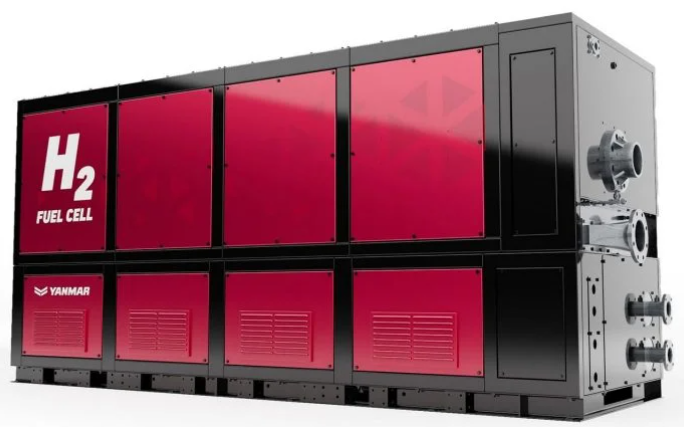
Yanmar Power Technology has achieved a significant milestone. Their GH320FC Maritime Hydrogen Fuel Cell System received Approval in Principle (AiP) from DNV, a leading classification society.
Source: Yanmar
Modular design
The GH320FC is designed for easy installation across various vessels. Its modular design allows multiple units to connect in parallel, meeting diverse power needs. This flexibility makes it ideal for coastal ferries, inland cargo ships, and port service vessels, especially in Europe’s low-emission zones.
The power output is 300 kW which bring the fuel cell into the larger segment, which is required for shipping’s multi-megawatt.
European decarbonization
Eric Tigelaar, Yanmar Europe’s Commercial Marine Department Manager, emphasized the system’s role in providing sustainable energy solutions. Masaru Hirose, General Manager at Yanmar Power Technology, highlighted its contribution to European decarbonization goals, building on successful deployments in Japan.
DNV’s Olaf Drews praised the system’s potential in achieving zero-emission operations. He noted that fuel cells with renewable fuels offer efficient, scalable power solutions for the maritime industry’s future.
This approval marks a pivotal step toward cleaner maritime operations. Yanmar’s innovation aligns with global efforts to reduce emissions and promote sustainable energy in marine transport.