Hydrogen news

  • China Launches Hydrogen-Powered Inland Container Vessel

    Just when you wonder why China is not exploring the potential of hydrogen as fuel for inland barges, news drops of the first vessel being launched already.

    China has taken a major step in advancing zero-emission maritime technology with the launch of its first large hydrogen fuel cell-powered inland container vessel, the Dong Fang Qing Gang. This innovative vessel highlights China’s commitment to reducing emissions from its inland shipping sector while exploring the potential of hydrogen fuel cell technology.

    Key Features of Dong Fang Qing Gang

    • Hydrogen Fuel Cells: The vessel is equipped with two 240 kW hydrogen fuel cells developed by Sinosynergy, marking the company’s entry into high-power maritime applications.
    • Hydrogen Storage: Its storage system holds 550 kg of hydrogen, enabling a range of approximately 235 miles.
    • Hybrid System: A lithium battery complements the hydrogen power system for increased efficiency.
    • Specifications: The vessel measures 64.9 meters, displaces 2,000 tons, and has a capacity of 64 TEU (equivalent to approximately 1,450 tons).

    Launched in Zhejiang Province on December 18, 2024, the vessel is set to undergo outfitting and testing, with commercial operations between Zhapu port (Jiaxing) and Xiasha port (Hangzhou) beginning in 2025.

    A Global Perspective: Dutch Innovations in Hydrogen Barges

    China’s Dong Fang Qing Gang reflects a growing global interest in hydrogen-powered inland shipping. The Netherlands, a leader in maritime innovation, has been pioneering similar solutions:

    1. Nobian’s Hydrogen Barge: Developed for the transport of salt and chemicals, the Antonie leverages hydrogen fuel cells to achieve emissions-free operation.
    2. Future Proof Shipping’s FPS Maas: Retrofitted with hydrogen fuel cells, the FPS Maas is already operational, showcasing the viability of hydrogen in commercial inland shipping.
    3. Condor H2 Hydrogen Container Swapping: This innovative Dutch system simplifies refueling by enabling hydrogen containers to be swapped seamlessly, ensuring minimal downtime and increased operational flexibility.

    Significance of Hydrogen-Powered Vessels

    Both the Dutch and Chinese initiatives underline the potential of hydrogen as a scalable, sustainable energy source for maritime transport.

    The launch of Dong Fang Qing Gang and similar projects around the world underscore the transformative potential of hydrogen in revolutionizing inland and coastal shipping.
    Categories: ,

  • December 2024 Norway subsidy results

    Hydrogen Projects score poorly in Norway’s latest Zero-Emission Vessel Funding

    Norway’s recent allocation of approximately $108 million to 14 zero-emission vessel projects underscores its commitment to sustainable maritime solutions. However, it’s notable that only two hydrogen-powered vessels received funding, despite numerous applications in this category.

    Among the projects awarded, Cruise Service AS secured the subsidy for two hydrogen-powered passenger vessels. Details are not known.

    The limited support for hydrogen initiatives is concerning, given hydrogen’s potential to revolutionize maritime transport, particularly in shortsea shipping. By not capitalizing on the opportunity to fund a broader range of hydrogen projects, Norway may be missing a chance to lead in this transformative technology.

    It’s encouraging to note that Enova plans to hold additional funding rounds, with the next call for hydrogen and ammonia programs anticipated at the end of the first quarter of 2025. This presents an opportunity to reassess and potentially increase support for hydrogen-based maritime solutions in future allocations.

    Categories: ,

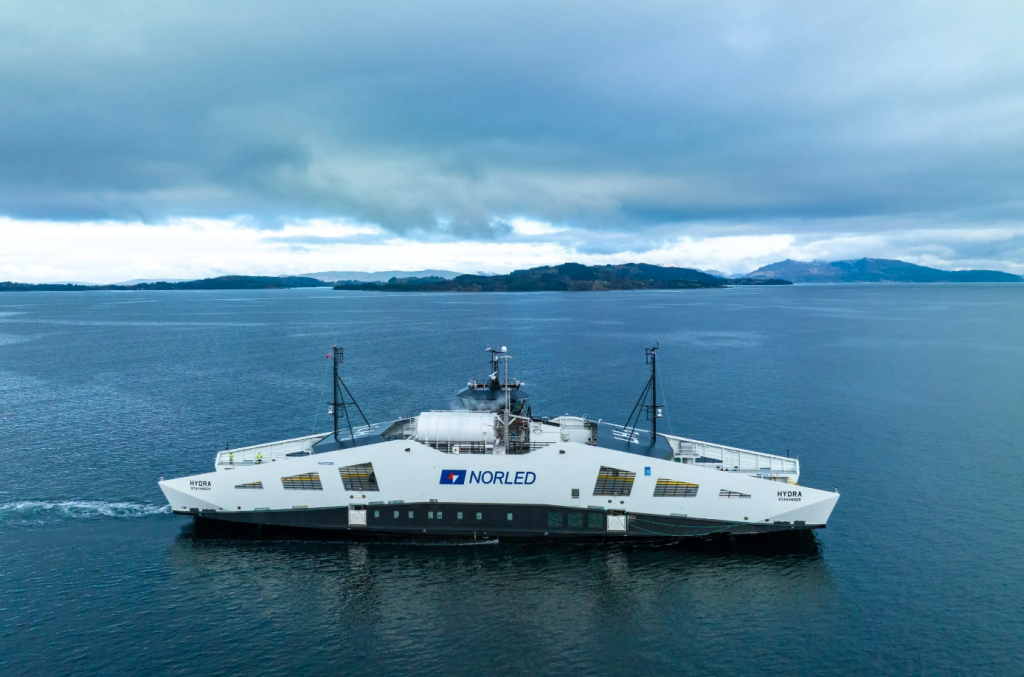
  • Ferry Hydra pioneering LH2

    a pioneering zero-emission passenger ferry powered by liquid hydrogen.

    Delivery

    In June 2021, the ferry Hydra was delivered from Westcon Yards AS to Norled AS in Stavanger, Norway. Designed by LMG Marine AS, Hydra is the world’s first passenger ferry capable of using hydrogen as fuel. It operates alongside the battery-powered ferry Nesvik on the Hjelmeland–Nesvik–Skipavik route.

    Norled's MF Hydra

    Fuel cells and batteries

    Hydra utilizes liquid hydrogen stored on board to power two hydrogen fuel cells, which continuously charge a large battery pack. The batteries can also be charged dockside at Hjelmeland and Nesvik. The ferry is designed to operate on fuel cells driven by liquid hydrogen for at least 50% of its operating time. Additionally, two diesel generators are installed as backup power sources.

    Norwegian party

    The construction of Hydra involved significant contributions from Norwegian suppliers, including LMG Marin in Bergen, Vestnes Ocean in Florø, Westcon Power & Automation in Haugesund, and AF Aeronmollier in Flekkefjord/Stavanger. In total, 18 Norwegian suppliers and exporters participated in the project, enhancing domestic value creation and supporting the maritime export industry. Export Financing Norway provided guarantees totaling up to 460 million NOK for these environmentally friendly ferry projects.

    Hydra is classified by DNV GL with the following notations: 1A Car Ferry B Battery (Power) E0 LC R4(Nor). The propulsion system features Schottel’s Rudder Propeller SRE 340 L FP. Main generators are Scania DI16 75M models, with Stamford HCM634G2 generators (480-553 kW), all supplied by Nogva Motorfabrikk. Westcon Power & Automation provided and installed the battery system.

    Deck equipment includes anchor winches and capstans from Adria Winch, a Marine Evacuation System (MES) and liferafts from Survitec, and an RSQ 450 G MOB boat from Palfinger. Lighting solutions, including searchlights, floodlights, navigation lights, and both exterior and interior technical lighting, were supplied by Glamox.

    Additional systems comprise ventilation and air conditioning from Novenco, comprehensive e-SEAmatic Blue system integration (including EMS, integrated bridge, IAS, and EPMS) by Westcon Power & Automation, navigation equipment installed by Vico, and CCTV provided by Ocean Electronics.

    Milestone

    The delivery of Hydra marks a significant milestone in the advancement of zero-emission maritime transport, showcasing innovative use of hydrogen fuel technology in passenger ferry operations.

  • Superyacht 821 on LH2

    Superyachts often waste engineering resources on gadgets like underwater elevators and mobile helidecks. It provides bragging rights to the owners but does nothing to advance the shipbuilding industry. Not so for Project 821. Building a multi-megawatt fuel cell system with liquid hydrogen storage in a closed environment is relevant for the entire shipbuilding industry. An engineering feat to be proud of.

    Project 821 is a groundbreaking superyacht launched by Dutch shipyard Feadship on May 4, 2024. Spanning 118.8 meters, it holds the distinction of being the world’s first hydrogen fuel cell-powered superyacht, marking a significant advancement in sustainable shipbuilding since the delivery of the first LH2-fuelled ferry Hydra.

    feadship project 821 launched

    Innovative Green Technology

    Project 821 employs green hydrogen to generate emission-free power for both propulsion and onboard amenities. This zero-diesel approach allows the yacht to operate silently and without emissions for up to a week while at anchor or cruising at 10 knots, significantly reducing its environmental impact.

    A key challenge in the yacht’s development was the safe storage of liquid hydrogen at extremely low temperatures (-253°C). Feadship addressed this by installing a double-walled cryogenic storage tank capable of holding approximately 4 tons of hydrogen. Additionally, the fuel cells can utilize methanol, offering flexibility in fuel sources.

    Design and Luxury Features

    Designed by British studio RWD, Project 821 seamlessly integrates luxury with cutting-edge technology. The yacht features five decks above water and two below, with 14 deploying balconies, five shell doors, and seven significant opening platforms—the most hull openings of any Feadship to date. These elements create a harmonious indoor-outdoor experience for guests.

    Liquid hydrogen installation

    MAN Cryo, a division of MAN Energy Solutions, supplied the liquid-hydrogen gas-fuel supply system, marking the first installation of such technology on a superyacht. Their scope encompassed the 92 cubic meter vacuum-insulated type C tank, a tank connection space with essential process equipment like vaporizers and control valves, a bunker station for shore-to-ship bunkering, control and automation systems , a vent mast, and interconnecting hydrogen piping.

    This innovative system stores hydrogen in liquid form, then evaporates and heats it to supply gaseous hydrogen to the fuel cell system, enabling the vessel’s zero-emission propulsion. MAN Cryo collaborated with Lloyd’s Register to develop a risk-assessment-based design approved for below-deck placement—a pioneering achievement in marine liquid-hydrogen projects.

    Technical Specifications

    • Length Overall: 118.8 meters (389’9″)
    • Beam: 19 meters (62’4″)
    • Draft: 5.25 meters (17’3″)
    • Propulsion: 2 x 3,200 kW ABB azimuthing thrusters
    • Power Supply:
    • 2 x 900 kW MTU generators
    • 3 x 2,500 kW MTU generators
    • 16 x 185 kW PowerCell hydrogen generators (fuel cells)
    • Tank: 92 m3 C-type
    • Range: 6,500 nautical miles at 14 knots
    • Accommodation: Up to 30 guests in 12 staterooms, with additional cabins for 44 crew members and 2 staff members

    Market Availability

    Shortly after its launch, Project 821 was listed for sale through yacht brokerage Edmiston. While there have been rumors linking the yacht to Microsoft co-founder Bill Gates, Feadship has not confirmed any details regarding ownership or pricing.