Norway’s state-owned Enova has awarded substantial funding for six hydrogen-powered bulk carriers, marking a significant acceleration in the deployment of zero-emission maritime technology. The latest round brings the total number of liquid hydrogen bulk carriers to four, demonstrating growing confidence in hydrogen as a viable marine fuel.
Expanding the Liquid Hydrogen Fleet
LH2 Shipping, in partnership with Strand Shipping Bergen (part of the Vertom Group), received approximately $29 million in additional funding from Enova to construct two more liquid hydrogen-powered bulk carriers. This award follows an earlier grant of $23.5 million secured in the spring for the first two vessels, bringing the total number of hydrogen-powered ships in the project to four.
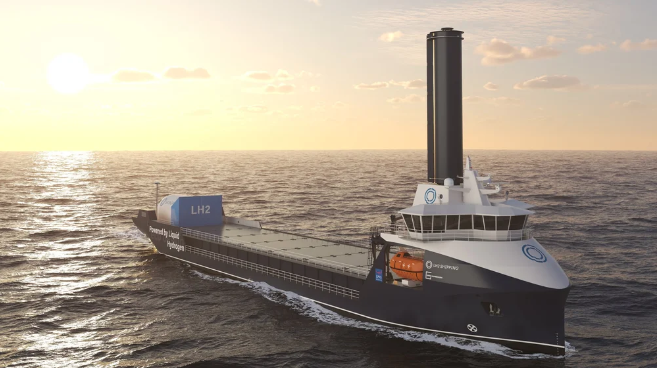
The expanded funding represents more than NOK 536 million ($52.5 million) in total state support for this single project—a clear signal of Norway’s commitment to maritime decarbonization.
Technical Specifications
The four vessels, branded under the “NordBulk” project, will be 7,700 dwt bulk carriers designed for short sea shipping. Each 108-meter (353-foot) vessel will transport bulk and general cargo between northern Norway, the Baltic region, and mainland Europe.
Key technical features:
- LH₂ Storage: 17 tonnes liquid hydrogen capacity per vessel
- Power Generation: 3.5 MW PEM fuel cells
- Battery Support: 1.5 MWh battery pack to support fuel cell operation
- Shore Power: Equipped for shore power connection during loading/unloading
- Backup System: Standby diesel/biodiesel generator for operational redundancy
The onboard hydrogen systems consist of C-type vacuum-insulated tanks storing liquid hydrogen at -253°C. This proven technology builds directly on the experience gained from Norled’s MF Hydra ferry, which has been operating successfully on liquid hydrogen since 2023.
Coastal Hydrogen Operations
In addition to the liquid hydrogen bulk carriers, GMI Rederi received funding to construct two coastal bulk carriers powered by compressed hydrogen. These vessels will combine multiple zero-emission technologies:
- Fuel cells running on compressed hydrogen
- Battery energy storage systems
- Wind-assisted propulsion technology
The ships will operate along the Norwegian coast, transporting asphalt and construction materials—applications where the shorter range and established coastal infrastructure make compressed hydrogen a practical choice.
Building the Supply Chain
A critical component of these projects is the parallel development of hydrogen production and bunkering infrastructure. In November 2024, Enova awarded over NOK 777 million ($70.9 million) to five hydrogen production projects along the Norwegian coast, from Slagentangen in the southeast to Bodø in the north.
These production facilities will provide:
- Total capacity: 120 MW
- Daily production: Approximately 40 tons of hydrogen
- Coverage: Strategic locations along major shipping routes
Nils Kristian Nakstad, CEO of Enova, stated: “The projects that receive support will be part of a network of hydrogen producers along the Norwegian coastline. This will make hydrogen more accessible to those who want to invest in sustainable shipping.”
The Economics of Hydrogen Shipping
The business case for hydrogen vessels is improving rapidly due to several factors:
Regulatory Drivers:
- EU Emissions Trading System (ETS) now includes maritime transport
- FuelEU Maritime regulations mandate gradual emissions reductions
- IMO’s 2050 net-zero target creates long-term regulatory certainty
Cost Competitiveness:
With carbon pricing mechanisms in place, the cost gap between fossil fuels and hydrogen is narrowing. After 2030, when CO₂ emission fees increase further under EU regulations, zero-emission vessels are expected to achieve operational cost parity with conventional ships on many routes.
The Enova grants cover up to 80% of the additional costs associated with hydrogen technology—a significant increase from the previous 40% support level. This enhanced support reflects Norway’s strategic goal to establish first-mover advantage in zero-emission shipping technologies.
Environmental Impact
The six hydrogen-powered bulk carriers receiving funding in this round will collectively contribute to:
- Annual CO₂ reduction: Significant emissions cuts in short-sea shipping
- Zero local emissions: No NOx, SOx, or particulate matter during fuel cell operation
- Scalable model: Demonstration of commercially viable hydrogen operations
Enova emphasizes that supporting these pioneer vessels creates the foundation for broader adoption. As Andreas Bjelland Eriksen, Norway’s Minister for Climate and Environment, stated: “Norway must be at the forefront of the transition at sea.”
Timeline and Next Steps
The vessels are expected to enter service between 2026 and 2029, with construction beginning in 2025. Shipyard selection is underway, with Norwegian and European yards competing for the contracts.
Enova has announced it will continue its support programs, with additional funding rounds planned for 2025 and 2026. The organization reports receiving 31 applications in the latest round, indicating strong industry interest in hydrogen and ammonia propulsion.
Industry Significance
This latest funding announcement positions Norway as the clear leader in hydrogen shipping deployment. The country’s comprehensive approach—supporting vessels, production facilities, and infrastructure simultaneously—creates the conditions for a functioning hydrogen maritime ecosystem.
For the global shipping industry, Norway’s hydrogen program provides crucial real-world data on:
- Operational costs of hydrogen vs. conventional fuel
- Reliability of liquid vs. compressed hydrogen systems
- Integration challenges in existing shipping operations
- Bunkering procedures and infrastructure requirements
As the maritime industry faces increasing pressure to decarbonize, Norway’s hydrogen pioneers are demonstrating that zero-emission bulk shipping is not just technically feasible—it’s becoming economically viable.
Looking Ahead
With four liquid hydrogen bulk carriers and two compressed hydrogen coastal vessels now funded and under development, Norway is creating a critical mass of hydrogen shipping operations. When these vessels enter service, they will provide the operational experience needed to scale hydrogen technology across larger ships and longer routes.
The success of these projects will be closely watched by shipowners worldwide, particularly in Europe where emissions regulations are tightening rapidly. If the NordBulk vessels demonstrate reliable, cost-competitive operations, they may catalyze a broader shift toward hydrogen in the short-sea shipping segment.
This article is based on reports from Maritime Executive, Ship & Bunker, Clean Shipping International, Norwegian Hydrogen, Hellenic Shipping News, and official Enova communications.
Leave a Reply