Truck-to-Ship Delivery
Mobile bunkering via tube trailers or cryogenic tankers—flexibility without port infrastructure investment
← Back to Bunkering Methods Overview
Where fixed infrastructure doesn’t exist or vessels require refueling at multiple locations, truck-based delivery provides essential flexibility. This approach has been pioneered by early hydrogen vessel operators who needed to prove concepts before infrastructure investment could be justified.
Truck-to-ship bunkering has become the dominant method for the current generation of hydrogen vessels, enabling operations across multiple ports without requiring each terminal to invest in permanent hydrogen infrastructure. Both compressed and liquid hydrogen can be delivered by truck, though the equipment and procedures differ significantly.
Compressed Hydrogen (CH₂) Truck Delivery
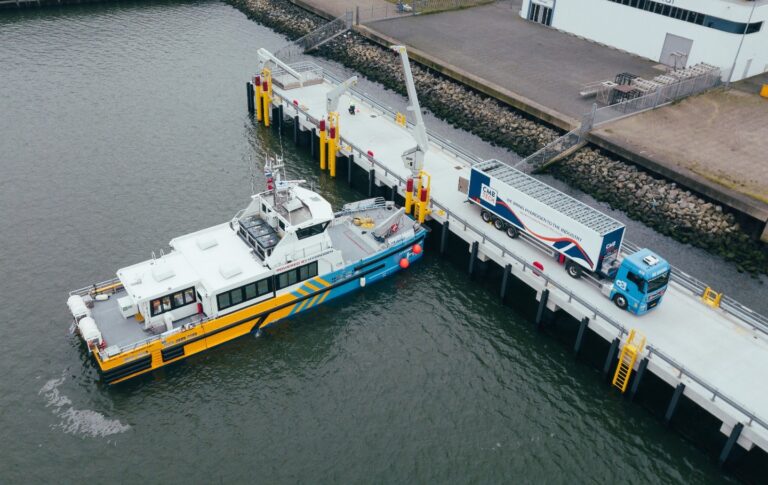
Mobile tube trailers—road-transportable pressure vessels typically at 200–500 bar—connect directly to vessel fuel systems via standardized coupling equipment. This has become the dominant bunkering method for the current generation of compressed hydrogen vessels.
How It Works
Tube trailers containing 200–500 kg of compressed hydrogen are positioned quayside. Transfer occurs through cascade filling, with gas flowing from high-pressure trailer tubes to lower-pressure vessel tanks. Operations typically complete in 2–6 hours depending on volume and pressure differential.
Key Advantages
- Minimal port infrastructure investment required
- Bunker at any quay with vehicle access
- Proven approach—multiple operators using today
- Equipment can serve multiple vessels/ports
- Lower operational complexity than LH₂
Operational Considerations
- Transfer rates limited by pressure differential (50–150 kg/hour)
- Multiple trailer trips may be needed for larger vessels
- Fuel costs include transport markup
- Weather and traffic can impact delivery schedules
- Road weight limits may constrain payload
Real-World Application: North Sea Operations
CMB.Tech and Windcat Offshore have pioneered truck-to-ship bunkering for their hydrogen-electric crew transfer vessels operating in the North Sea. This flexibility proved essential during early deployment when dedicated infrastructure simply didn’t exist at most offshore energy hubs.
Tube trailers are dispatched to whichever port the vessel’s operational schedule demands, eliminating the constraint of returning to a single bunkering location.
Liquid Hydrogen (LH₂) Truck Delivery
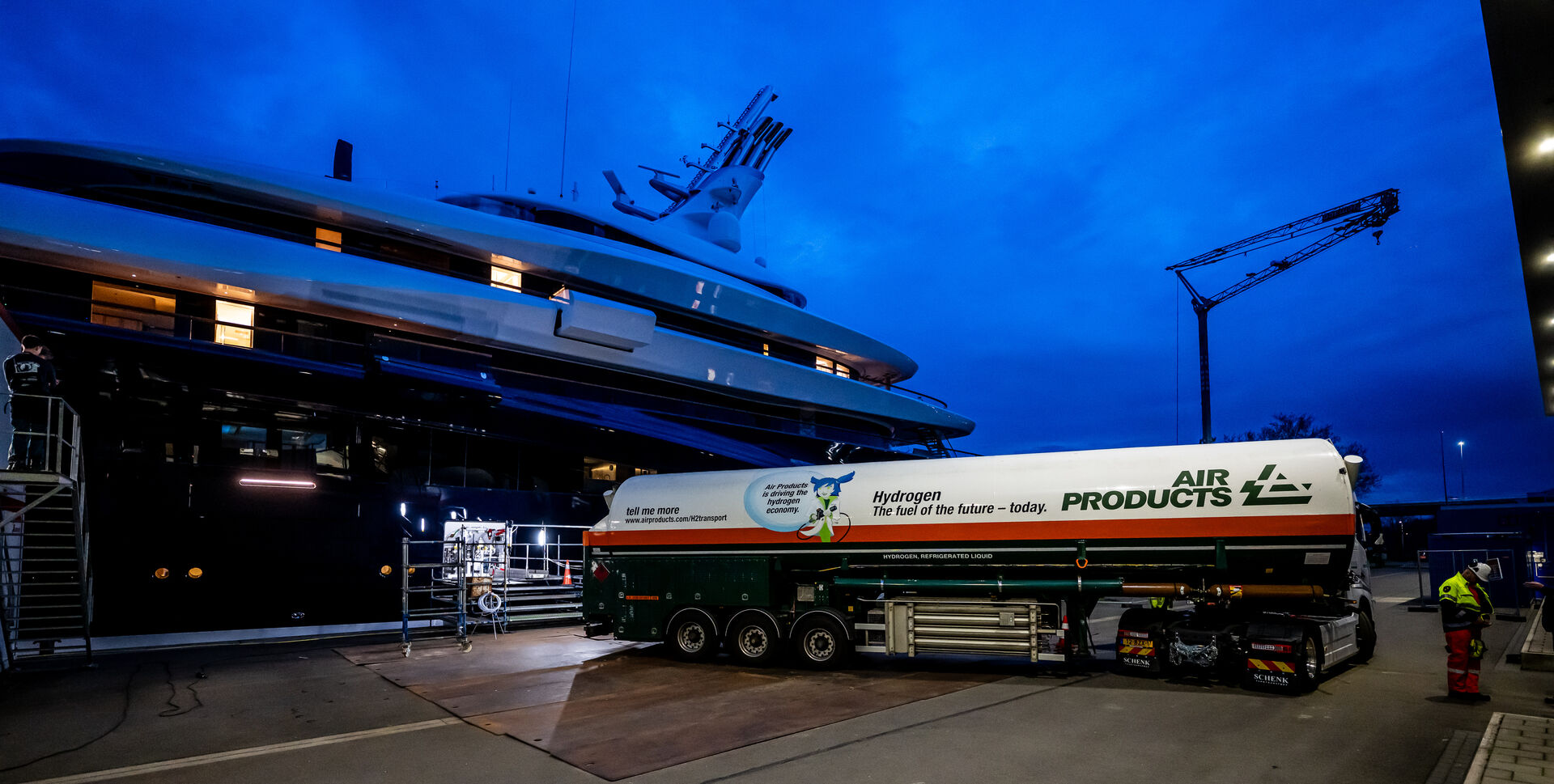
Cryogenic tanker trucks (typically 3,000–4,500 kg LH₂ capacity) connect to vessels via specialized transfer equipment. While more complex than compressed hydrogen truck operations, this approach enables LH₂ bunkering at any port with suitable quayside access—critical during the early deployment phase before fixed infrastructure develops.
How It Works
Vacuum-insulated tanker trucks transport LH₂ from liquefaction plants or import terminals to the vessel’s berth. Transfer occurs via cryogenic flexible hoses or fixed coupling systems, typically requiring 2–4 hours for a full bunkering operation depending on vessel capacity and pressure conditions.
Key Advantages
- Enables LH₂ bunkering without port infrastructure investment
- Flexible—serve multiple ports with same assets
- Scalable as fleet grows
- Lower barrier to entry for vessel operators
- Can bridge gap until fixed infrastructure develops
Operational Considerations
- Boil-off losses during transport and transfer
- Limited to ports within economic trucking distance of supply
- Weather sensitivity for cryogenic operations
- Requires trained personnel at each bunkering
- Road access and weight restrictions at some quaysides
Operational Example: MF Hydra at Hjelmeland
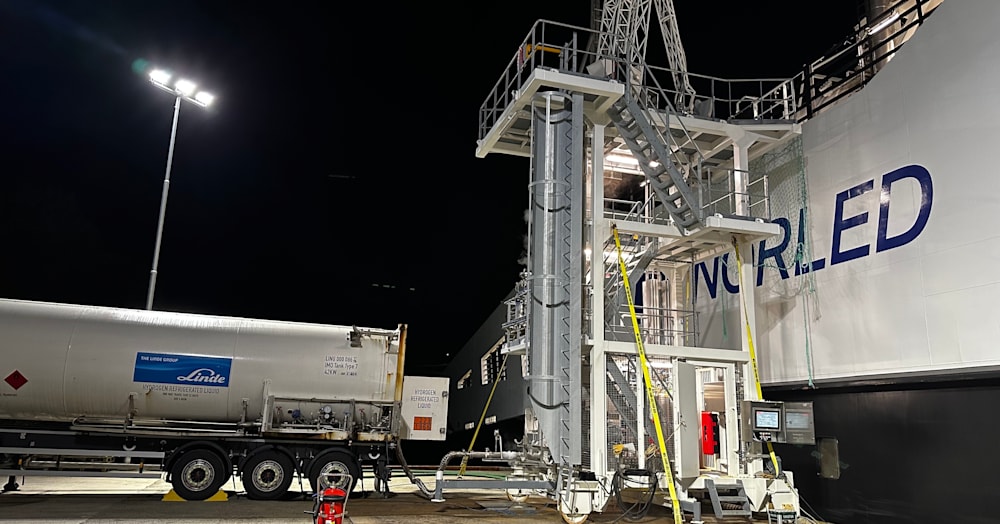
Norled’s MF Hydra, the world’s first liquid hydrogen ferry, relies on truck-based LH₂ delivery at Hjelmeland, Norway. Cryogenic tanker trucks transport liquid hydrogen from the Linde facility to the ferry terminal, where bunkering occurs during scheduled turnarounds.
This approach enabled operational experience to accumulate while demonstrating the viability of liquid hydrogen as a marine fuel—proving the concept before committing to permanent shore infrastructure.
CH₂ vs LH₂ Truck Delivery Comparison
| Parameter | CH₂ Tube Trailer | LH₂ Cryogenic Tanker |
|---|---|---|
| Typical Payload | 200–500 kg | 3,000–4,500 kg |
| Transfer Rate | 50–150 kg/hour | 200–500 kg/hour |
| Operating Conditions | 200–500 bar, ambient | 1–10 bar, -253°C |
| Transfer Duration (typical) | 2–6 hours | 2–4 hours |
| Equipment Complexity | Moderate | High (cryogenic) |
| Personnel Training | High-pressure gas handling | Cryogenic + high-pressure |
| Operational Status | In Service | In Service |
Logistics & Planning
Supply Chain Factors
- Distance from H₂ production to port
- Road access and weight restrictions
- Delivery scheduling coordination
- Multiple trips if vessel demand exceeds payload
- Return trip logistics (empty trailers)
Operational Planning
- Align bunkering with vessel turnaround windows
- Weather contingency for outdoor operations
- Backup supplier arrangements
- Safety zone establishment at quayside
- Port authority coordination
Cost Factors
- Transport distance markup on fuel price
- Trailer/tanker rental or ownership
- Driver and operator costs
- Boil-off losses (LH₂)
- Multiple delivery fees if required
Regulatory Requirements
- ADR certification for road transport
- Port dangerous goods protocols
- Operator certification requirements
- Emergency response procedures
- Insurance and liability coverage
When to Choose Truck-to-Ship
Ideal Conditions
- Operating across multiple ports
- Testing new routes before infrastructure commitment
- Ports without fixed H₂ infrastructure
- Early-stage fleet deployment
- Modest bunkering volumes
- Need operational flexibility
Consider Alternatives If
- Single-port, high-frequency operation (→ fixed installation)
- Very large bunkering volumes required
- Offshore bunkering needed (→ ship-to-ship)
- Minimal turnaround time critical (→ container swap)
- No H₂ supply within economic trucking distance