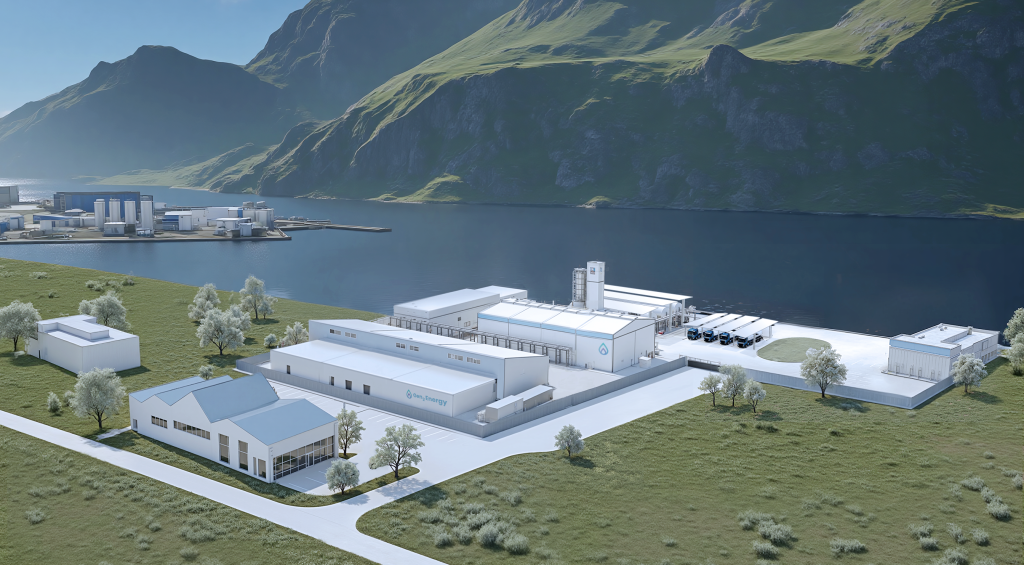
Gen2 Energy has received confirmation of a total capacity reservation of 195 MW for its green hydrogen production project at Nesbruket in Vefsn municipality, Norway. This grid connection represents one of the largest capacity allocations for hydrogen production in Norway and positions the facility to produce approximately 42 tons of green hydrogen daily when fully operational. The project has already received its general building permit—the largest hydrogen plant to achieve this milestone in Norway—and is progressing toward final investment decision for construction start in 2026.
Strategic Location in Norway’s Hydrogen Heartland
The Nesbruket facility sits adjacent to Alcoa’s aluminum smelter in Mosjøen, at the end of the 48-kilometer Vefsnfjorden in the Helgeland region. This location is no accident—Mosjøen is positioned in the heart of Norway’s largest hydropower resources, with massive amounts of trapped renewable energy that can power large-scale electrolysis operations cost-effectively.
The 195 MW capacity reservation from the grid operator represents the electrical infrastructure foundation necessary to produce hydrogen at commercial scale. This isn’t just paperwork—it’s the difference between a hydrogen project that remains on drawing boards and one that can actually operate profitably.
Project Specifications
The Nesbruket plant represents Gen2 Energy’s first phase in a broader Mosjøen hydrogen hub strategy that could eventually encompass 695 MW of total production capacity across two sites.
Nesbruket Plant 1 key features:
- Grid Capacity: 195 MW reserved
- Production Capacity: Approximately 42 tons of green hydrogen per day
- Technology: Water electrolysis powered by renewable hydroelectric energy
- Export Method: Compressed hydrogen in 40-foot ISO containers
- Target Markets: European industrial customers and maritime applications
- Port Access: Deep-water quay facilities via Port of Helgeland
- Planned Start: Production targeted for 2027
Gen2 Energy is also developing Nesbruket Plant 2 adjacent to the first facility, which will supply hydrogen “over the fence” to neighboring company Norsk e-Fuel for sustainable aviation fuel (SAF) production. Additionally, a 500 MW facility is planned for Holandsvika, further along the Vefsnfjord.
The Grid Capacity Bottleneck
Securing 195 MW of grid capacity might sound like administrative procedure, but it represents one of the most critical bottlenecks in the hydrogen economy. Large-scale electrolysis requires massive amounts of electricity—current estimates suggest power costs account for 60-80% of green hydrogen’s operational expenses.
Without sufficient grid connection capacity, even the best-designed hydrogen plant cannot operate. Grid operators must carefully balance total demand across all users, and reserving 195 MW for a single facility requires coordination with transmission system operators, load forecasts, and infrastructure upgrades.
Norway’s hydropower advantage provides both abundant renewable electricity and—critically—baseload renewable power. Unlike solar or wind which produce intermittently, hydropower can provide steady output, allowing electrolyzers to run at high capacity factors. This operational consistency directly impacts project economics and hydrogen production costs.
Why This Matters
Grid capacity reservations like Gen2 Energy’s 195 MW allocation are the unsexy infrastructure reality that determines whether hydrogen projects move from PowerPoint to production. Europe’s hydrogen strategy targets 10 million tons of domestic production by 2030—requiring approximately 120 GW of electrolyzer capacity. But electrolyzers are useless without grid connections to power them. Norway’s combination of cheap hydropower, available grid capacity, and proximity to European markets positions projects like Nesbruket to produce cost-competitive green hydrogen while competitors in other regions struggle with expensive renewable electricity and grid connection delays stretching years. More importantly, the “over the fence” hydrogen supply to Norsk e-Fuel demonstrates how hydrogen hubs create industrial ecosystems where production facilities, export operations, and local consumers co-locate to minimize logistics costs and maximize infrastructure utilization—a model that could be replicated across Norway and Europe.
Economics of Scale
The economics of green hydrogen production hinge on three primary factors: electricity cost, electrolyzer capital cost, and capacity factor (how much of the time the system operates). Gen2 Energy’s Nesbruket location optimizes all three.
Norway’s hydropower provides electricity costs significantly below European averages. The Norwegian government estimates current green hydrogen production costs around €5.20 per kilogram, with power and grid connection representing approximately 60% of total costs. As electrolyzer costs decline through mass production and the facility operates at high capacity factors enabled by steady hydropower, production costs should trend toward the €3-4/kg range by the late 2020s.
This pricing trajectory is critical. Grey hydrogen produced from natural gas costs roughly €1-2/kg today. Green hydrogen needs to approach €3/kg to compete in industrial applications without subsidies. The combination of cheap Norwegian power, high utilization rates, and economies of scale at 195 MW capacity positions Nesbruket to reach competitive pricing faster than projects relying on more expensive electricity or intermittent renewable sources.
Partnership with Norsk e-Fuel
Gen2 Energy’s partnership with Norsk e-Fuel illustrates the hydrogen hub model’s potential. Norsk e-Fuel is developing a sustainable aviation fuel (SAF) facility on neighboring land at Nesbruket. Rather than building separate hydrogen production, Norsk e-Fuel will receive hydrogen “over the fence” directly from Gen2 Energy’s Nesbruket Plant 2.
This arrangement optimizes capital efficiency—one large hydrogen production facility serving multiple customers achieves better economies of scale than several smaller dedicated plants. It also minimizes hydrogen transportation costs and energy losses, since the hydrogen moves via short pipelines rather than compression, storage, and trucking.
Lars Bjørn Larsen, CCO of Norsk e-Fuel, emphasized the partnership’s strategic value: “Through strategic partnerships such as the one with Gen2 Energy, based on a shared commitment to innovation and efficient use of power and other resources, our collaboration not only facilitates the exchange of expertise, but also drives sustainable land use optimization and promotes cost efficiency.”
Andreas Ekker, SVP Global Sales at Gen2 Energy, noted: “The short distance supply of hydrogen from our Nesbruket plant 2 to our neighbour Norsk e-Fuel is cost-efficient for both parties and represents a significant steppingstone towards the realization of the industrial ambitions in Vefsn municipality.”
Norway’s Broader Hydrogen Strategy
Gen2 Energy’s Nesbruket development aligns with Norway’s national hydrogen strategy, which targets hydrogen as a central pillar in the country’s transition to becoming a low-emission society by 2050. The government’s 2020 hydrogen strategy recognizes that achieving 90-95% emissions reductions compared to 1990 levels requires decarbonizing sectors where direct electrification proves challenging.
Norway has committed significant public funding to accelerate hydrogen development. Enova, the Norwegian state enterprise managing climate and energy transition investments, allocated NOK 777 million (approximately €65 million) in November 2024 to support five green hydrogen production facilities targeting maritime applications. These investments complement private sector projects like Gen2 Energy’s Nesbruket plant.
The country’s abundant hydropower resources—Norway generates approximately 95% of its electricity from hydropower—provide the clean energy foundation for large-scale hydrogen production without requiring massive solar or wind buildouts. However, Norway’s electrolyzer manufacturing capacity remains limited, with most equipment being imported from suppliers like Nel Hydrogen, thyssenkrupp nucera, and international competitors.
Competitive Landscape
Gen2 Energy faces competition from several Norwegian hydrogen developers. Norwegian Hydrogen is developing a 270 MW facility at Ørskog in Ålesund municipality, targeting 40,000 tons of annual production. Greenstat has begun constructing a 20 MW facility at Fiskå in Rogaland County as part of the Agder Hydrogen Hub in Kristiansand.
However, Gen2 Energy’s 195 MW capacity at Nesbruket—potentially expanding to 695 MW across Mosjøen facilities—positions the company among Norway’s largest hydrogen producers. The early building permit, secured grid capacity, and partnership with Norsk e-Fuel provide competitive advantages in a sector where many projects remain in earlier development stages.
Internationally, Norway competes with countries like Chile and Morocco that benefit from extremely cheap solar power for electrolysis. A 2024 academic study estimated Norwegian green hydrogen costs at €5.18-7.25/kg compared to potentially lower costs in sunnier regions. However, Norway’s advantages lie in proximity to European markets, established energy infrastructure, political stability, and existing industrial ecosystems—factors that matter as much as production cost alone.
Looking Ahead
With grid capacity secured and permits in hand, Gen2 Energy approaches the critical final investment decision phase. The company has completed FEED work with Wood, engaged equipment suppliers, and established customer relationships through partnerships like Norsk e-Fuel and commitments to European export customers.
The 195 MW grid capacity reservation transforms Nesbruket from hydrogen project to hydrogen reality—a critical step in Norway’s ambition to become a major European hydrogen supplier and prove that green hydrogen can compete economically with fossil fuel alternatives.
Sources
- Gen2 Energy – “Gen2 Energy AS and Vefsn municipality have signed agreements on green hydrogen” (September 2021)
- Gen2 Energy – “Agreement on the planning and design of the quay entered and application for general building permit delivered” (July 2023)
- Gen2 Energy – “General building permit for the hydrogen plant in Mosjøen in place” (September 2023)
- Gen2 Energy – “Gen2 Energy and Norsk e-Fuel partner on green hydrogen for production of sustainable aviation fuel” (January 2024)
- Gen2 Energy – Production Sites information (gen2energy.com)
- Wood – “Wood secures FEED for first large-scale green hydrogen production facility in Mosjøen in Norway” (May 2022)
- Offshore Energy – “Gen2 Energy, Vefsn municipality sign green hydrogen deal” (September 2021)
- CMS Law – “Hydrogen law and regulation in Norway” (November 2024)
- Green Hydrogen Organisation – “Norway Country Profile” (2024)
- ScienceDirect – “The competitive edge of Norway’s hydrogen by 2030: Socio-environmental considerations” (August 2024)
Leave a Reply