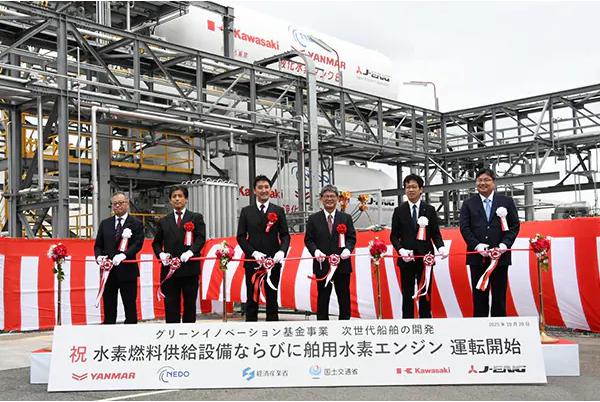
On October 28, 2025, Kawasaki Heavy Industries, Yanmar Power Solutions, and Japan Engine Corporation announced the successful completion of the world’s first land-based operation of marine hydrogen engines. The demonstration took place at Japan Engine’s headquarters factory in Japan, utilizing a newly installed liquefied hydrogen fuel supply system manufactured by Kawasaki.
The Three Engines: A Full Power Range
What makes this project particularly significant is the coordinated development of engines covering the full spectrum of marine propulsion needs—from auxiliary power to main propulsion:
| Manufacturer | Type | Model | Engine Speed | Rated Output |
|---|---|---|---|---|
| Kawasaki Heavy Industries | Medium-speed 4-stroke | 8L30KG-HDF | 720 min⁻¹ | 2,600 kW |
| Yanmar Power Solutions | Medium-speed 4-stroke | 6EY22ALDF-H | 900 min⁻¹ | 800 kW |
| Japan Engine Corporation | Low-speed 2-stroke | 6UEC35LSGH | Max. 167 min⁻¹ | Max. 5,610 kW |
All three engines feature dual-fuel capability, allowing them to switch between hydrogen and diesel fuel. This redundancy is critical for early adopters concerned about H₂ supply reliability. Kawasaki and Yanmar have already demonstrated stable hydrogen combustion at rated output in their medium-speed four-stroke engines. Japan Engine’s low-speed two-stroke engine—the workhorse of deep-sea shipping—is scheduled for first operation in Spring 2026.
The LH₂ Fuel Supply System
Kawasaki’s liquefied hydrogen fuel supply system (MHFS) is the backbone of this demonstration. The system stores and gasifies liquid hydrogen, supplying it at both high and low pressure to accommodate the different engine types:
- Low-speed two-stroke main propulsion engines (J-ENG)
- Four-stroke auxiliary engines (Yanmar)
- Four-stroke main generator engines for electric propulsion ships (Kawasaki)
The ability to serve multiple engine configurations from a single fuel system is a practical engineering solution that could simplify future vessel designs.
Funding: Japan’s JPY 2 Trillion Green Innovation Fund
This project is part of NEDO’s Green Innovation Fund Projects under the “Next-Generation Ship Development” initiative, specifically the “Development of Marine Hydrogen Engine and MHFS” program.
Green Innovation Fund Details
- Total Fund Size: JPY 2 trillion (~US$13 billion)
- Additional Allocations: JPY 300 billion (FY2022) + JPY 456.4 billion (FY2023)
- Managing Organization: NEDO (New Energy and Industrial Technology Development Organization)
- Government Backing: METI (Ministry of Economy, Trade and Industry)
Japan declared its carbon neutrality goal in October 2020, and this fund represents one of the most substantial national investments in maritime decarbonization globally. For context, this dwarfs even the EU Innovation Fund’s maritime allocations.
Industry Context: Japan’s Hydrogen Shipping Push
This consortium milestone comes amid a flurry of hydrogen activity in Japan:
- April 2025: Yanmar Power Technology received DNV Approval in Principle (AiP) for its GH320FC maritime hydrogen fuel cell system—designed for coastal passenger ferries, inland waterway cargo vessels, and port service vessels
- March 2025: Tsuneishi Shipbuilding launched Japan’s first hydrogen dual-fuel tug with high-power internal combustion engine and 250 kg compressed H₂ storage (see our Ships page)
- January 2025: Yanmar received government approval for its hydrogen-fueled engines and fuel cell systems production plan under the “Zero Emission Ship Construction Promotion Project”
Japan is pursuing a dual-track approach: fuel cells for harbor and coastal applications, and hydrogen ICE for larger vessels requiring higher power outputs. The consortium’s engines—ranging from 800 kW to 5,610 kW—fill a gap that fuel cells cannot yet cost-effectively address.
Hydrogen ICE vs. Fuel Cells: The Engineering Trade-Off
From a naval architect’s perspective, the choice between hydrogen internal combustion engines and fuel cells involves significant trade-offs:
Hydrogen ICE Advantages:
- Lower capital cost than fuel cells at equivalent power
- Familiar technology for crews and shipyards
- Dual-fuel capability provides operational flexibility
- Better suited for high-power applications (>2 MW)
Hydrogen ICE Limitations:
- Lower efficiency than fuel cells (~44% peak vs. ~50-60% for PEMFCs)
- Still produces NOₓ emissions (though no CO₂)
- Requires pilot fuel in dual-fuel mode, reducing emissions benefit by up to 12.5%
The consortium’s approach—starting with dual-fuel engines that can later run on pure hydrogen as infrastructure matures—represents a pragmatic path forward.
Challenges Ahead
⚠️ BOTTLENECK: LH₂ Supply Infrastructure
While the land-based demonstrations are complete, the real test will be onboard operation. Key challenges remain:
- Liquefied hydrogen bunkering infrastructure is virtually non-existent for marine applications
- Cryogenic storage at -253°C requires specialized tank systems with boil-off management
- Classification rules for hydrogen-fueled vessels are still evolving
- Crew training for H₂ handling remains a significant undertaking
The consortium will need to work closely with shipowners and shipyards to address these practical considerations before commercial deployment.
Next Steps: From Shore to Sea
The consortium has outlined a clear roadmap:
- ✅ Land-based demonstrations (Completed October 2025)
- 🔄 J-ENG two-stroke engine operation (Spring 2026)
- 📋 Onboard trials with shipowners and shipyards (Timeline TBD)
- 🚢 Commercial implementation (Target: Before 2050)
The involvement of all three major Japanese marine engine manufacturers—unified under NEDO coordination—positions Japan to become a leader in marine hydrogen ICE technology, complementing fuel cell developments from the same companies.
What This Means for Ship Operators
For operators considering hydrogen propulsion, this milestone offers several takeaways:
- Dual-fuel hydrogen engines will be available across a range of power outputs suitable for everything from auxiliary generators to main propulsion
- Japanese manufacturers are positioning themselves as credible suppliers alongside European competitors like MAN and Wärtsilä
- The LH₂ fuel system validated here could become a template for future vessel designs
- Government support through programs like the Green Innovation Fund reduces technology risk for early adopters
As the consortium moves toward onboard trials, the maritime industry will be watching closely. Japan has made its bet on hydrogen—both fuel cells and internal combustion—and this demonstration brings commercial viability one step closer to reality.
Sources
- Yanmar Holdings Co., Ltd. Press Release (October 28, 2025)
- Japan Engine Corporation Press Release (October 28, 2025)
- NEDO Green Innovation Fund Projects
- Ship Technology (October 29, 2025)
- Marine Link (October 28, 2025)