HydrogenShipbuilding.com

click to database

Category: Ferry

  • Gotlandsbolaget’s Hydrogen-Ready High-Speed Ferry

    I have to admit the hydrogen system of this vessel is not very clear yet. What means hydrogen ready? However we can see hydrogen storage containers at the bow open deck area. Therefore very good to see these kind of vessels being introduced with hydrogen as fuel.

    Austal Australasia

    Austal Australasia has secured a contract valued between A$265 and A$275 million to design and construct a 130-meter, hydrogen-ready high-speed ferry for Sweden’s Gotlandsbolaget. This vessel, part of the ‘Horizon X’ program, will be the largest ever built by Austal. It will feature a unique combined cycle propulsion system that includes both gas and steam turbines—a first for high-speed craft worldwide. The ferry will have the capacity to transport up to 1,500 passengers, 400 vehicles, and cargo. Construction is scheduled to begin in the first half of 2026 at Austal’s Philippines shipyard, utilizing ‘green aluminium’ produced through energy-efficient processes to reduce emissions. Completion is expected by mid-2028.
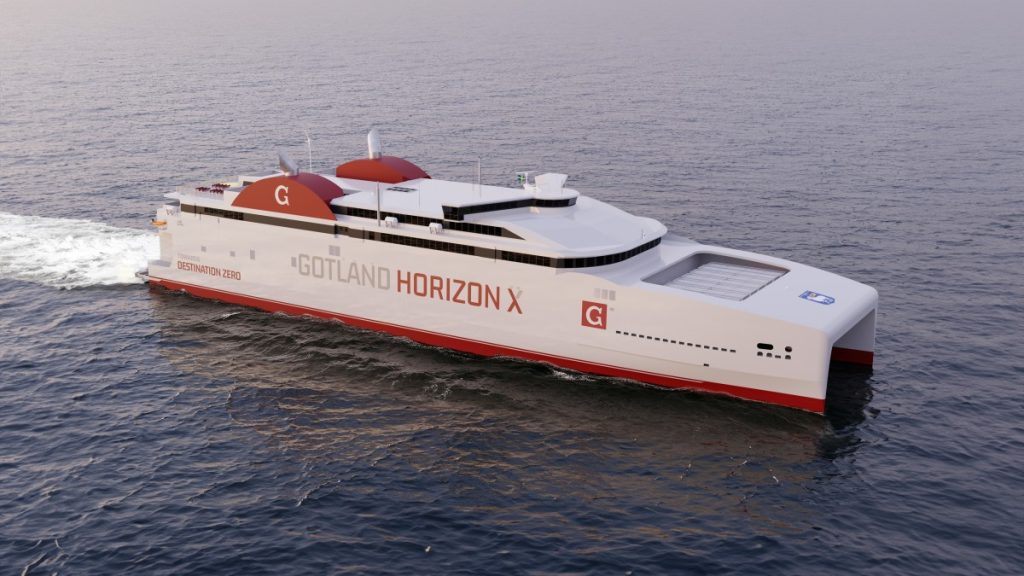
    Source: Austal

    Combined cycle propulsion system

    The combined cycle propulsion system enhances efficiency by repurposing engine exhaust to power steam turbines, reducing overall fuel consumption and emissions. This design allows for flexibility in fuel types, including hydrogen, aligning with global decarbonization efforts in maritime transport. The vessel’s hydrogen-ready configuration means it can transition to zero-emission operations as hydrogen fuel becomes more accessible. In October 2024, the project received approval in principle from the international classification society DNV, confirming compliance with regulations for gas-fueled ship installations and the International Code of Safety for Ships Using Gases or Other Low Flashpoint Fuels.

    Collaboration

    Austal and Gotland Tech Development have collaborated with global technology providers to refine the vessel’s propulsion system. This partnership has focused on selecting preferred equipment and defining system arrangements that repurpose engine exhaust to contribute to vessel propulsion, thereby reducing emissions. The use of ‘green aluminium’ in construction further underscores the project’s commitment to sustainability, as this material is produced using energy-efficient processes that result in lower carbon emissions.

    This project represents a significant advancement in sustainable maritime transport, combining innovative propulsion technology with environmentally friendly materials to set new standards in eco-friendly ferry design.
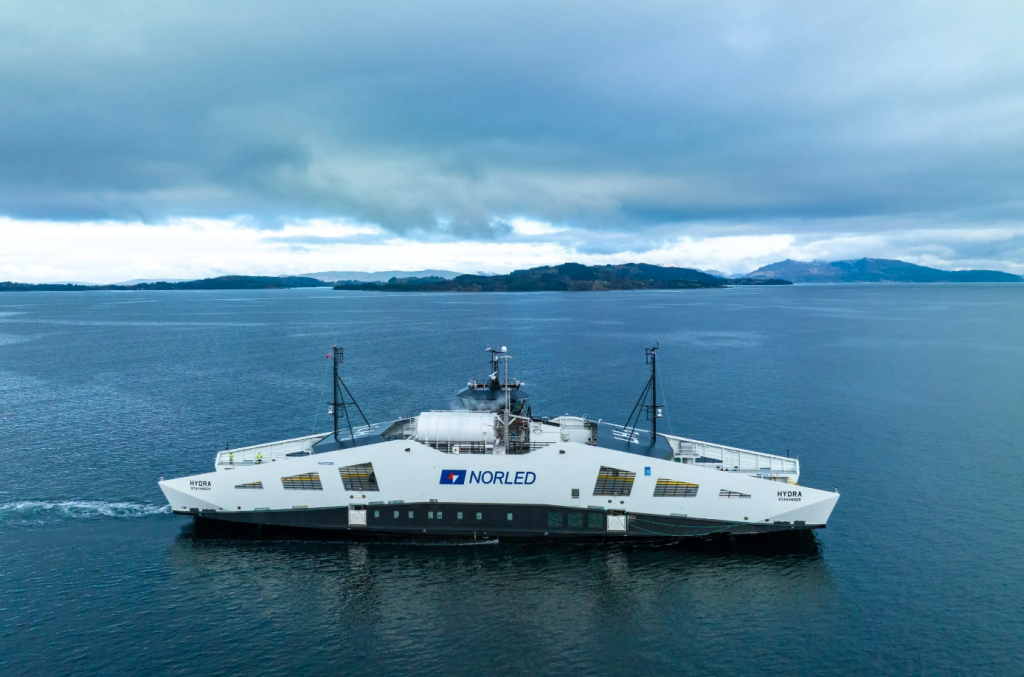
  • Ferry Hydra pioneering LH2

    a pioneering zero-emission passenger ferry powered by liquid hydrogen.

    Delivery

    In June 2021, the ferry Hydra was delivered from Westcon Yards AS to Norled AS in Stavanger, Norway. Designed by LMG Marine AS, Hydra is the world’s first passenger ferry capable of using hydrogen as fuel. It operates alongside the battery-powered ferry Nesvik on the Hjelmeland–Nesvik–Skipavik route.

    Norled's MF Hydra

    Fuel cells and batteries

    Hydra utilizes liquid hydrogen stored on board to power two hydrogen fuel cells, which continuously charge a large battery pack. The batteries can also be charged dockside at Hjelmeland and Nesvik. The ferry is designed to operate on fuel cells driven by liquid hydrogen for at least 50% of its operating time. Additionally, two diesel generators are installed as backup power sources.

    Norwegian party

    The construction of Hydra involved significant contributions from Norwegian suppliers, including LMG Marin in Bergen, Vestnes Ocean in Florø, Westcon Power & Automation in Haugesund, and AF Aeronmollier in Flekkefjord/Stavanger. In total, 18 Norwegian suppliers and exporters participated in the project, enhancing domestic value creation and supporting the maritime export industry. Export Financing Norway provided guarantees totaling up to 460 million NOK for these environmentally friendly ferry projects.

    Hydra is classified by DNV GL with the following notations: 1A Car Ferry B Battery (Power) E0 LC R4(Nor). The propulsion system features Schottel’s Rudder Propeller SRE 340 L FP. Main generators are Scania DI16 75M models, with Stamford HCM634G2 generators (480-553 kW), all supplied by Nogva Motorfabrikk. Westcon Power & Automation provided and installed the battery system.

    Deck equipment includes anchor winches and capstans from Adria Winch, a Marine Evacuation System (MES) and liferafts from Survitec, and an RSQ 450 G MOB boat from Palfinger. Lighting solutions, including searchlights, floodlights, navigation lights, and both exterior and interior technical lighting, were supplied by Glamox.

    Additional systems comprise ventilation and air conditioning from Novenco, comprehensive e-SEAmatic Blue system integration (including EMS, integrated bridge, IAS, and EPMS) by Westcon Power & Automation, navigation equipment installed by Vico, and CCTV provided by Ocean Electronics.

    Milestone

    The delivery of Hydra marks a significant milestone in the advancement of zero-emission maritime transport, showcasing innovative use of hydrogen fuel technology in passenger ferry operations.