HydrogenShipbuilding.com

click to database

Author: J

  • Germany’s Coriolis: World’s First Research Vessel with Metal Hydride Hydrogen Storage Now Operational


    Germany’s Coriolis: World’s First Research Vessel with Metal Hydride Hydrogen Storage Now Operational

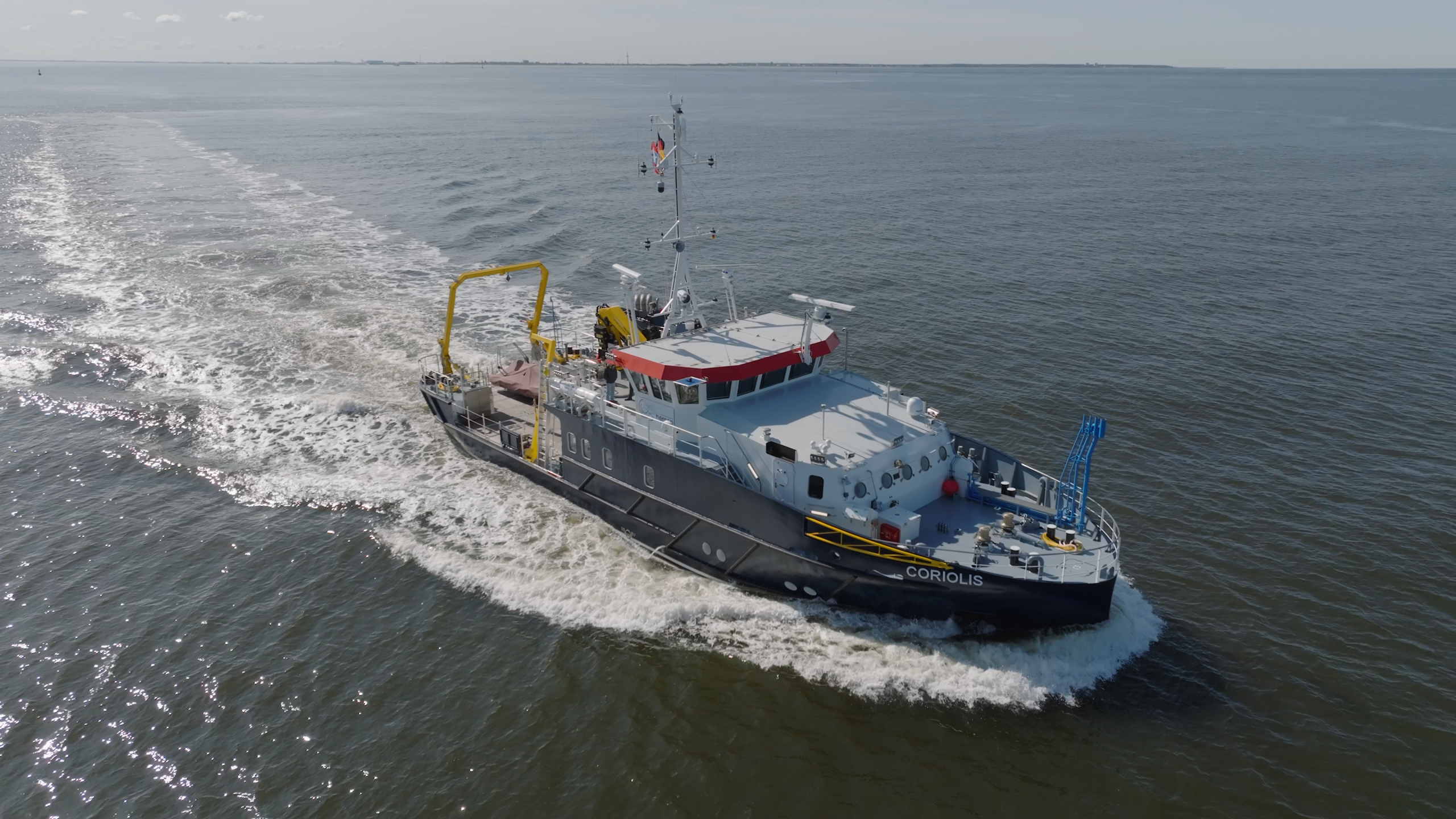
    The research vessel Coriolis at its christening ceremony at Hitzler Werft shipyard in Lauenburg, Germany, November 18, 2024
    The research vessel Coriolis at its christening ceremony at Hitzler Werft shipyard in Lauenburg, Germany, November 18, 2024. The 29.9-meter vessel features the world’s first commercial application of metal hydride hydrogen storage. Photo: Hereon/Marcel Schwickerath

    As a naval architect, I find the Coriolis project particularly exciting—not just because it’s another hydrogen vessel joining the fleet, but because it’s a floating laboratory specifically designed to advance the very technologies it uses. The fact that Hereon chose to develop and test their own metal hydride storage system on this vessel, rather than relying on conventional compressed or liquid hydrogen solutions, demonstrates the kind of bold experimentation the industry needs right now.

    Germany’s Helmholtz-Zentrum Hereon has officially taken delivery of the research vessel Coriolis, marking a significant milestone in both marine hydrogen technology and coastal research. Christened on November 18, 2024, at the Hitzler Werft shipyard in Lauenburg, the 29.9-meter vessel represents a globally unique approach to maritime hydrogen propulsion—using metal hydride storage technology developed in-house by Hereon’s Institute of Hydrogen Technology.

    The €18 million vessel, funded primarily by the German Federal Government, was delivered in January 2025 and is now operational for research missions in the North Sea, Baltic Sea, and shallow coastal waters.

    What sets Coriolis apart is its dual purpose: it’s simultaneously a coastal research platform and an innovation testbed for hydrogen maritime technologies, specifically designed to validate the metal hydride storage system developed by Hereon. Named after French scientist Gaspard Gustave de Coriolis (1792-1843), the vessel entered service in early 2025.

    Vessel Specifications

    Key Technical Data:

    • Length Overall: 29.9 meters (98.1 feet)
    • Beam: 8.0 meters (26 feet)
    • Draught: 1.6 meters (5.2 feet)—shallow enough for Wadden Sea operations
    • Maximum Speed: 12 knots
    • Range: 100 nautical miles
    • Crew: 2 (+1 optional)
    • Scientists: Up to 12
    • Operating Days/Year: 225
    • Laboratory Space: 47 m²
    • Working Deck: 70 m² with stern A-frame
    • Total Engine Power: 750 kW

    Innovative Propulsion System

    The Coriolis employs a hybrid diesel-electric, battery-electric, and hydrogen-electric propulsion concept. Electric traction motors drive the vessel’s two propellers and can draw power from three different sources:

    1. 100 kW Hydrogen Fuel Cell: Supplied by hydrogen from the metal hydride storage system
    2. Battery Bank: For short-term, high-power demands
    3. 45 kW Diesel Generator: Backup power for extended missions

    Hydrogen Operation Duration: Approximately 5 hours on a single tank charge in pure hydrogen mode.

    The Metal Hydride Storage Breakthrough

    What Makes Metal Hydride Storage Different?

    The Coriolis is the first commercial research vessel to use metal hydride (MH) hydrogen storage instead of conventional compressed (350-700 bar) or liquid hydrogen (-253°C) systems. This technology, previously used in German U212 and U214 class submarines, offers several distinct advantages for maritime applications:

    Storage Capacity:

    • Metal Hydride Tank System: 5 tonnes total weight
    • Hydrogen Capacity: 30 kg of hydrogen
    • Volumetric Density: >50 g H₂/liter at system level
    • Operating Pressure: <60 bar (vs. 350-700 bar for compressed hydrogen)
    • Operating Temperature: -30°C to +50°C (vs. -253°C for liquid hydrogen)

    Safety Advantages:

    • Chemical bonding prevents sudden release of hydrogen in case of valve failure or pressure vessel rupture
    • Only 5-10% residual hydrogen could be released abruptly due to porosity
    • Much safer than high-pressure or cryogenic storage in marine environments

    Design Flexibility:

    • Metal hydride tanks can be shaped to fit ship structure
    • Can replace ballast water, improving space utilization and stability
    • Modular cascade system allows for redundancy and scalability

    The Challenge

    Metal hydride formation generates heat that must be managed through cooling systems. The vessel uses waste heat recovery to improve overall energy efficiency of the hydrogen system.

    Key Partners and Technology Providers

    • Owner/Operator: Helmholtz-Zentrum Hereon, Institute of Surface Science
    • Shipyard: Hitzler Werft, Lauenburg, Germany (construction: January 2023 – January 2025)
    • Design Office: TECHNOLOG Services GmbH, Hamburg
    • Metal Hydride System: Developed in-house by Hereon’s Institute of Hydrogen Technology
    • Fuel Cell: 100 kW PEM fuel cell
    • Total Project Cost: €18 million (German Federal Government funding)

    The vessel was christened on November 18, 2024, by Karin Prien, Schleswig-Holstein’s Minister of Science, before approximately 400 guests from politics, science, and industry.

    Industry Context: Research Vessels Leading Hydrogen Adoption

    Research vessels are proving to be ideal platforms for hydrogen technology development:

    Similar Hydrogen Research Vessels:

    • Energy Observer (France): Liquid hydrogen-powered catamaran
    • Hydra (Norway): Liquid hydrogen ferry with LOHC testing capability
    • H₂ Barge 1 (Netherlands): Inland hydrogen bunker and supply vessel

    The research vessel segment benefits from:

    • Controlled operational profiles with known routes and durations
    • On-board scientific teams capable of monitoring and optimizing systems
    • Strong government funding for technology demonstration
    • Lower commercial pressure allowing for innovation testing

    The Coriolis takes this concept further by making hydrogen technology itself a primary research subject, not just a propulsion solution.

    Connection to H2Mare Flagship Project

    The Coriolis directly supports Germany’s H2Mare hydrogen flagship project, one of three major initiatives funded by the German Federal Ministry of Education and Research (BMBF) with up to €740 million total allocation. H2Mare focuses on producing green hydrogen and derivative products using offshore wind power.

    Hereon contributes to H2Mare through four of its institutes, advancing:

    • Offshore hydrogen production technologies
    • Hydrogen storage and transport solutions
    • Membrane-based gas separation and purification
    • System integration for maritime applications

    Operational Challenges and Considerations

    While the Coriolis represents technological advancement, several practical challenges remain:

    Hydrogen Infrastructure:

    ⚠️ BOTTLENECK: Germany currently has limited hydrogen bunkering infrastructure for vessels. The Coriolis will need to coordinate with specialized facilities or use mobile refueling solutions.

    Operational Range:

    • 5 hours of pure hydrogen operation limits extended offshore missions
    • 100 nautical mile total range requires careful mission planning
    • Diesel backup essential for current operations until hydrogen supply chain matures

    Refueling Logistics:

    • Metal hydride refueling requires cooling capacity during hydrogen loading
    • Refueling time longer than conventional fueling but safer than liquid hydrogen
    • Specialized training needed for crew and port personnel

    Technology Validation Period:

    As this is the world’s first commercial application of metal hydride storage in a research vessel, 2025 will be a critical year for validating:

    • System reliability in varied sea conditions
    • Practical refueling procedures
    • Heat management during extended operations
    • Overall operational economics

    Why Metal Hydrides Matter for Maritime Hydrogen

    The Coriolis demonstrates a storage solution that could be particularly attractive for smaller vessels and harbor craft:

    Advantages for Maritime Applications:

    • Safety: Lower pressure and ambient temperature reduce explosion risk
    • Structural Integration: Flexible tank shapes can optimize ship design
    • Stability: Dense storage low in hull improves metacentric height
    • Ballast Replacement: Hydrogen storage serves dual purpose
    • No Boil-Off: Unlike liquid hydrogen, no fuel is lost during storage

    Current Limitations:

    • Weight Penalty: 5 tonnes of tank system for only 30 kg hydrogen (167:1 ratio)
    • Energy Density: Still lower than diesel on a total system basis
    • Cooling Requirements: Heat management adds complexity
    • Cost: Specialized metal alloys and tank fabrication increase expenses
    • Refueling Speed: Slower than compressed hydrogen due to thermal constraints

    However, for vessels with predictable routes, shore-based power access, and weight tolerance, metal hydrides offer compelling safety and design advantages that could make them the preferred solution for certain applications.

    Looking Ahead: Metal Hydride Hydrogen as a Maritime Solution

    As the Coriolis begins operations in 2025, the maritime hydrogen industry will be watching closely. Key questions to be answered:

    1. Can metal hydride storage achieve the reliability needed for commercial maritime service?
    2. Will the safety and design advantages offset the weight penalty and refueling complexity?
    3. Can the technology scale up for larger vessels or be optimized for specific niches like harbor tugs, ferries, and coastal workboats?
    4. What refueling infrastructure investments will be required to support metal hydride vessels?

    Real-time operational data from Coriolis—available via the public dashboard—will provide invaluable insights for the broader maritime hydrogen transition. Every operational hour, every refueling cycle, every equipment performance metric becomes a data point that advances our collective understanding of metal hydride storage at sea. This is exactly the kind of real-world validation the hydrogen shipping sector needs to move from concept to commercial deployment.

    Conclusion: A Critical Test Platform for Maritime Hydrogen

    The €18 million investment in the Coriolis represents more than just a new research vessel for Germany—it’s a commitment to developing practical, safe hydrogen technologies specifically optimized for maritime environments. By making the vessel itself an experimental platform for metal hydride storage, Hereon has created a powerful feedback loop between hydrogen research and real-world maritime application.

    As Prof. Regine Willumeit-Römer, Scientific Director at Hereon, stated during the christening: “CORIOLIS will become our brand ambassador by researching complex systems… It is not only fundamental for coastal research, but also a tool for our entire center, because hydrogen and membrane technology are also used on board.”

    The vessel is expected to operate approximately 225 days per year, ensuring extensive operational data collection for metal hydride hydrogen storage validation. With Germany’s ambitious hydrogen strategy and the expansion of offshore wind capacity in the North and Baltic Seas, the Coriolis arrives at exactly the right moment to help demonstrate whether metal hydride storage can be a practical solution for the maritime sector’s transition to zero-emission operations.


    Sources

    • Baird Maritime: “VESSEL REVIEW | Coriolis – Hybrid hydrogen-powered research vessel delivered to German science institute” (January 21, 2026)
    • Helmholtz-Zentrum Hereon official website: Research Vessel Coriolis project pages
    • Innovations Report: “Hereon Unveils New Ship CORIOLIS in Grand Naming Ceremony” (November 20, 2024)
    • Power-to-X.de: “Research vessel Coriolis to embark on missions in 2025” (December 16, 2024)
    • NOW GmbH: “Onboard power for the CORIOLIS” (January 25, 2024)
    • German Federal Ministry of Education and Research (BMBF) H2Mare project information

  • New EMSA Study: Why Hydrogen Ships Can’t Use LNG Safety Playbook

    New EMSA Study: Why Hydrogen Ships Can’t Use LNG Safety Playbook | HydrogenShipbuilding.com

    Finally, we have the comprehensive safety data we’ve been waiting for. EMSA’s H-SAFE study, published November 2025, delivers what the hydrogen shipping industry desperately needed: hard numbers showing exactly where our assumptions about adapting LNG systems fall short. As someone who’s reviewed countless “hydrogen-ready” designs that were really just LNG systems with blue paint, this report is a reality check. The message is clear—secondary enclosures around ALL leak sources aren’t a nice-to-have feature, they’re non-negotiable. And that includes piping on open deck.

    The European Maritime Safety Agency (EMSA) just released the final report from DNV’s multi-year H-SAFE study investigating hydrogen fuel system safety. This isn’t another theoretical exercise—it’s quantitative risk analysis, HAZID workshops, and bowtie modeling across both compressed (CH₂) and liquefied (LH₂) systems. The findings fundamentally challenge the industry’s default assumption that hydrogen can be handled like LNG with minor modifications.

    The Numbers That Matter

    Here’s what jumps out from the technical analysis:

    Ignition Energy: Hydrogen’s minimum ignition energy is 0.017 mJ compared to 0.28 mJ for methane. That’s 16 times easier to ignite. Your certified electrical equipment? The study explicitly states you must assume ignition will occur anyway.

    Flammability Range: 4-75% for hydrogen versus 5-15% for natural gas. This isn’t a minor difference—it’s a 5x wider explosive window that makes inerting strategies far more complex.

    Burning Velocity: 3.46 m/s for hydrogen versus 0.45 m/s for methane. Translation: explosions are more severe and can transition to detonation more readily.

    Detection Response Time: The study found that conventional point gas detectors respond too slowly. At leak rates as low as 0.1 kg/s, ignitable clouds form within seconds—long before your detection system triggers emergency shutdown.

    The Secondary Enclosure Mandate

    The EMSA Guidance takes a more conservative position than the draft IMO Interim Guidelines on one critical point: ALL potential hydrogen leak sources should be protected within secondary enclosures—and that explicitly includes piping on open deck, not just enclosed spaces.

    Why the stricter approach? Three reasons backed by data:

    • Open deck leak detection is challenging. Wind, weather, and rapid dispersion make reliable detection uncertain.
    • Critical clouds form faster than detection systems respond. You can’t rely on catching leaks before ignition.
    • Industry best practice supports it. Both ISO 15916 and NASA guidelines recommend assuming ignition sources are present.

    For compressed hydrogen systems, this means inerted tank connection enclosures with nitrogen or helium. For liquefied hydrogen, it means vacuum-jacketed piping throughout—not just in the tank connection space.

    The Reliability Data Gap

    Here’s the sobering reality: leak frequency analysis has high uncertainty because we lack maritime-specific hydrogen equipment failure data. The study used generic HCRD and HyRAM+ databases, but neither accounts for ship motion, saltwater corrosion, or limited maintenance access during voyages.

    Current estimates suggest one leak event every 10 years for a four-tank compressed hydrogen system—but actual frequencies may be higher given data limitations. Heat exchangers, compressors, and valves are identified as the primary risk drivers.

    LH₂’s Cryogenic Challenge

    For liquefied hydrogen systems, the study identifies loss of vacuum insulation as a credible event that cannot be excluded from design. At -253°C, hydrogen is cold enough to liquefy air. When vacuum insulation fails:

    • External tank surfaces cool below air’s condensation point
    • Liquefied air with oxygen enrichment up to 50% forms on ship steel
    • Low-temperature embrittlement causes structural damage
    • Boil-off rates increase 10-50x normal levels

    The guidance requires ships using LH₂ to be designed to safely accommodate vacuum loss—not just detect and respond to it.

    The Human Factor

    Perhaps most concerning: analysis of 575 hydrogen accidents in the HIAD 2.0 database shows nearly 50% involve human and organizational errors. Safety management system factors account for 49% of incidents, individual human errors for 29%.

    This means even perfect technical design isn’t enough. Robust training programs, proper procedures, and active safety culture cultivation are non-negotiable for hydrogen operations.

    What This Means for Your Project

    If you’re designing or operating a hydrogen-fuelled vessel:

    1. Budget for secondary enclosures everywhere. This isn’t optional equipment you can value-engineer out.
    2. Design for substantial leaks. Small leak management won’t cut it—consider up to full-bore rupture.
    3. Invest heavily in training. Human factors dominate accident causation.
    4. Plan for data uncertainty. Your risk assessment will have wide confidence intervals until maritime-specific failure data exists.
    5. For LH₂ projects: design structures for cryogenic exposure. Tank support structure and surrounding ship steel must handle vacuum loss scenarios.

    The Bunkering Gap

    One significant finding: there’s no harmonized international guidance for shore-side hydrogen bunkering operations. Every port authority and jurisdiction has different requirements, making infrastructure development challenging. EMSA recommends developing comprehensive goal-based bunkering standards—something the industry urgently needs as the hydrogen fleet grows.

    Read the Full Technical Analysis

    This summary barely scratches the surface. The complete EMSA H-SAFE study includes detailed bowtie analysis for every major hazard scenario, frequency calculations for specific equipment failures, consequence modeling for collision and fire scenarios, and comprehensive guidance spanning 20 chapters.

    Read our complete deep dive technical analysis covering:

    • Detailed reliability analysis with equipment-specific failure rates
    • Complete comparison of CH₂ tank connection enclosure configurations
    • LH₂ vacuum insulation loss cascade analysis
    • Occupational safety hazards and human factors findings
    • Paragraph-by-paragraph comparison with IMO draft guidelines
    • Comprehensive prescriptive requirements from EMSA Guidance

    Industry Implications

    The IMO Interim Guidelines are expected for formal approval in 2026. Some flag States and classification societies may adopt the more conservative EMSA approach—particularly in early operational years as experience is gained. Projects currently under construction should review their designs against these findings to identify any gaps.

    For the broader industry, this study validates that hydrogen IS viable as marine fuel—but only with purpose-built safety systems that respect its unique properties. The days of “LNG-ready ships with hydrogen capability” are over. It’s time for hydrogen-specific design from the ground up.

    Have you encountered design decisions in your project that conflict with these findings? Our comprehensive technical deep dive provides the detailed analysis you need for engineering discussions.


    Source

    • Study: European Maritime Safety Agency (2025), “Study investigating the safety of hydrogen as fuel on ships,” Final Report, EMSA, Lisbon
    • Study Code: EMSA/OP/21/2023
    • Publication: November 14, 2025
    • Authors: DNV (Linda Hammer, Marius Leisner, Hans Jørgen Johnsrud, Olav Tveit, Torill Grimstad Osberg, Peter Hoffmann)
  • TEN-OH: Japan’s First Hydrogen Dual-Fuel Tugboat Begins Demonstration Operations

    TEN-OH hydrogen dual-fuel tugboat - Japan's first hydrogen-powered tug
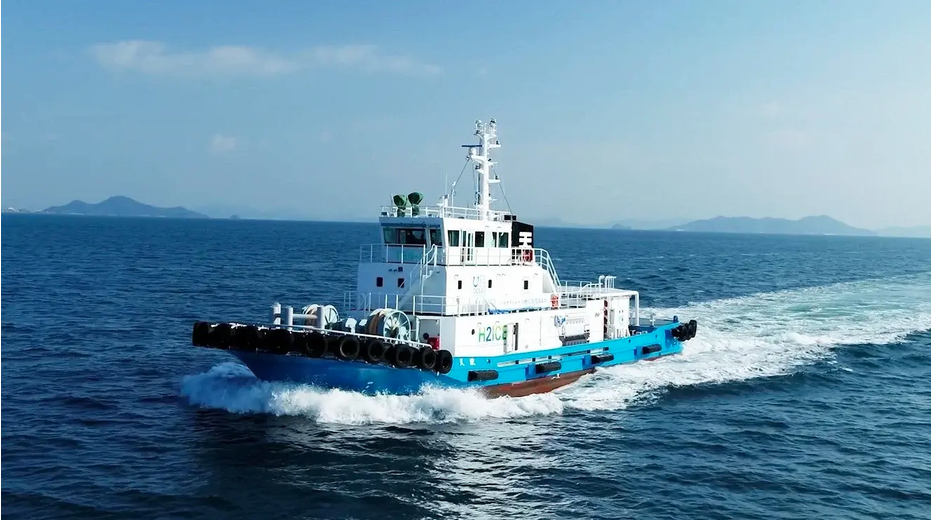
    TEN-OH, Japan’s first hydrogen dual-fuel tugboat. Credit: Tsuneishi Shipbuilding

    Japan continues to demonstrate its commitment to maritime decarbonisation with substance over hype. The TEN-OH isn’t just another concept vessel—it’s a fully operational, high-power tugboat now entering commercial demonstration. What makes this particularly noteworthy is the technology partnership: Belgian expertise from CMB.TECH combined with Japanese shipbuilding precision. This is exactly the kind of international collaboration the hydrogen transition requires.

    Japan’s first hydrogen dual-fuel tugboat, TEN-OH, has begun demonstration operations following its delivery by Tsuneishi Shipbuilding in October 2025. The 38-meter vessel represents a significant milestone in Japan’s Zero Emission Ships Project and marks the second deployment of BeHydro’s hydrogen combustion technology in a commercial tugboat—following the successful Hydrotug 1 at the Port of Antwerp-Bruges.

    The vessel is now conducting demonstration voyages and bunkering operations, with trials scheduled to continue through 2026.

    Technical Specifications

    Specification Value
    Vessel Name TEN-OH
    Length Overall 38.0 m
    Breadth 9.6 m
    Draft 4.2 m
    Gross Tonnage <300 GT
    Main Engines Twin BeHydro 12-cylinder hydrogen dual-fuel ICE
    Power Output 4,400 hp class (~3.3 MW total)
    Hydrogen Storage ~250 kg (high-pressure compressed)
    Fuel Type Hydrogen + traditional marine fuels [CH2]
    CO₂ Reduction ~60% vs. conventional tugboats
    Classification ClassNK

    Why Hydrogen Tugboats Matter

    Tugboats are deceptively important vessels for maritime decarbonisation. They operate in ports—areas increasingly under scrutiny for air quality and emissions—and require substantial power for manoeuvring large vessels. A typical harbour tug runs its engines at high loads for extended periods, making them significant emissions sources despite their modest size.

    The challenge for hydrogen tugboats is maintaining the high power output and reliability that port operations demand. TEN-OH addresses this directly with its twin 12-cylinder engines delivering 4,400 horsepower—matching conventional tug performance while significantly reducing emissions.

    Dual-Fuel Redundancy

    A critical design feature: in the event of hydrogen fuel system failure, TEN-OH can continue operating solely on marine fuel. This redundancy maintains the same safety standards as conventional vessels—essential for harbour operations where reliability is non-negotiable.

    International Technology Partnership

    TEN-OH’s propulsion system comes from JPNH2YDRO, a joint venture between Tsuneishi Group and CMB.TECH. The BeHydro engines are manufactured by a joint venture between Anglo Belgian Corporation (ABC) and CMB.TECH—the same partnership that delivered engines for Hydrotug 1.

    Key Technology Partners

    • Shipbuilder: Tsuneishi Shipbuilding (Fukuyama, Japan)
    • Hydrogen Systems: JPNH2YDRO (Tsuneishi Group + CMB.TECH)
    • Engines: BeHydro (ABC + CMB.TECH)
    • Classification: ClassNK
    • Steel: JGreeX green steel by JFE Steel Corporation

    The use of JGreeX green steel throughout the vessel’s construction adds another layer of sustainability—reducing the embodied carbon of the vessel itself, not just operational emissions.

    Context: The Growing Hydrogen Tug Fleet

    TEN-OH joins a small but growing fleet of hydrogen-powered tugboats worldwide. The most direct comparison is Hydrotug 1, operational at the Port of Antwerp-Bruges since late 2023:

    Specification TEN-OH (Japan) Hydrotug 1 (Belgium)
    Length 38.0 m 30.2 m
    Power ~3.3 MW (4,400 hp) 4 MW
    H₂ Storage ~250 kg 415 kg
    Bollard Pull Not specified 65 tonnes
    Engines BeHydro 12-cyl dual-fuel BeHydro V12 dual-fuel
    Emission Reduction ~60% ~65%

    Both vessels use the same core BeHydro technology, demonstrating that hydrogen dual-fuel combustion is now proven and scalable across different vessel designs and operating environments.

    The Nippon Foundation Zero Emission Ships Project

    TEN-OH was developed under the Nippon Foundation’s Zero Emission Ships Project, which aims to achieve carbon neutrality in Japan’s coastal shipping sector by 2050. The project is developing and demonstrating several vessel types:

    • TEN-OH: Hydrogen dual-fuel tugboat (delivered October 2025)
    • Hanaria: Hydrogen fuel cell + biodiesel passenger vessel (completed certification voyages in 2024)
    • Hydrogen tankers and cargo vessels: Planned trials through fiscal 2026

    Japanese Hydrogen Leadership

    Japan holds more hydrogen patents than any other country. The Zero Emission Ships Project aims to leverage this technical expertise to lead the global shipping industry toward carbon neutrality—exporting not just vessels but complete hydrogen propulsion solutions.

    Funding & Policy Support

    The project benefits from Japan’s substantial commitment to hydrogen technology through the Green Innovation Fund, a ¥2 trillion (~€12.5 billion) programme managed by NEDO (New Energy and Industrial Technology Development Organization). This fund supports the entire hydrogen value chain for shipping:

    • Marine hydrogen engine development (Kawasaki, Yanmar, Japan Engine)
    • Liquefied hydrogen fuel supply systems
    • Vessel construction and demonstration
    • Bunkering infrastructure development

    Separately, the Japanese Ministry of the Environment and Ministry of Land, Infrastructure, Transport and Tourism have approved Yanmar’s production plan for hydrogen-fuelled engines and fuel cell systems—signalling regulatory support for scaling production.

    ⚠️ The Dual-Fuel Question

    While TEN-OH’s 60% emission reduction is significant, the dual-fuel approach means it still burns conventional marine fuel alongside hydrogen. Critics note that without consistent access to green hydrogen and operational discipline, such vessels could default to running primarily on diesel.

    The demonstration phase will be critical in establishing realistic operational profiles and proving that high hydrogen utilisation rates are achievable in daily port operations.

    Project Timeline

    • March 2025: TEN-OH launched at Tsuneishi Shipbuilding, Fukuyama
    • October 9, 2025: ClassNK classification completed
    • October 15, 2025: Delivery to operator
    • 2025-2026: Demonstration voyages and bunkering trials
    • 2026+: Expected transition to commercial operations

    What This Means for the Industry

    TEN-OH’s demonstration phase will provide valuable operational data for the broader hydrogen shipping transition. Key questions to watch:

    • What hydrogen utilisation rates are achievable in real port operations?
    • How does bunkering logistics work for compressed hydrogen in a busy port environment?
    • What maintenance and training requirements emerge from commercial operation?
    • Can the 60% emission reduction target be consistently achieved?

    Tsuneishi Shipbuilding has indicated it will apply the expertise gained from TEN-OH to future vessel projects, including methanol-fuelled and LNG-fuelled ships. The company sees hydrogen as one pathway in a multi-fuel strategy for maritime decarbonisation.

    For port operators considering hydrogen tugs, TEN-OH and Hydrotug 1 together demonstrate that the technology works. The remaining questions are about infrastructure, fuel supply, and operational economics—challenges that become clearer only through real-world demonstration.

    Related Resources on HydrogenShipbuilding.com

    Sources & References

    • Tsuneishi Shipbuilding (October 2025). Official press release: “TSUNEISHI Delivered the Japan’s First Hydrogen Dual-Fuelled Tugboat”
    • The Maritime Executive (October 2025). “Japan’s First Hydrogen Dual-Fuel Tugboat Delivered to Begin Demonstrations”
    • Offshore Energy (October 2025). “Japan’s first hydrogen dual-fuel tugboat sees the light of day”
    • ClassNK (October 2025). Classification announcement for hydrogen-fueled tugboat TEN-OH
    • CMB.TECH (December 2023). “Port of Antwerp-Bruges & CMB.TECH launch the Hydrotug 1”
    • The Nippon Foundation. Zero Emission Ships Project documentation
    • NEDO Green Innovation Fund Projects. Development of Marine Hydrogen Engine and MHFS programme information
  • IEA Global Hydrogen Review 2025: Key Highlights for Shipping

    IEA Global Hydrogen Review 2025: Key Highlights for Shipping

    IEA Global Hydrogen Review 2025: Key Highlights

    Summary for Shipping & Cost Perspectives

    The International Energy Agency’s Global Hydrogen Review 2025 is one of the most comprehensive annual assessments of the hydrogen sector worldwide. While the report takes a broad view—covering everything from industrial applications to road transport and power generation—it remains highly relevant for those of us focused specifically on maritime decarbonisation. The sections on hydrogen-derived fuels for shipping, port infrastructure readiness, and bunkering economics provide valuable data that’s difficult to find elsewhere. Even the general cost projections and policy updates help contextualise where maritime hydrogen applications fit within the wider energy transition. Below, I’ve distilled the key takeaways most relevant to shipping and hydrogen economics.

    The Big Picture

    Global hydrogen demand reached almost 100 million tonnes in 2024, up 2% from 2023. Low-emissions hydrogen production grew 10% and is on track to reach 1 Mt in 2025, but still accounts for less than 1% of global production. Despite project delays and cancellations, the sector continues to mature with more than 200 low-emissions hydrogen projects having received final investment decisions since 2020.

    Hydrogen for Shipping: Key Takeaways

    Fleet Growth and Momentum

    • 60+ methanol-powered ships are now on the water as of June 2025
    • ~300 additional methanol-powered ships are on order books
    • Ships expected for delivery in 2028: only one-third will have conventional oil engines; methanol-powered ships represent ~10% of gross tonnage
    • 30+ ammonia-powered ships are on order, with deliveries starting late 2025

    IMO Net-Zero Framework (Potential Game-Changer)

    Approved in April 2025, the framework introduces fuel emission intensity standards and a GHG pricing mechanism. Note: Final adoption is expected around October 2026, with enforcement beginning Q1 2028—though these timelines remain subject to ongoing negotiations and are not yet finalised.

    • Fuel emission intensity standards with two trajectories (base target and direct compliance target)
    • GHG pricing mechanism:
      • Tier 2 pricing: USD 380/t CO₂-eq for fuels above base target
      • Tier 1 pricing: USD 100/t CO₂-eq for fuels above direct compliance target
    • Zero or near-zero rewards for fuels below 19 g CO₂-eq/MJ

    Bunkering Infrastructure at Ports

    • Marine fuel bunkering is highly concentrated: Singapore alone supplies ~20% of global demand; just 17 ports cover >60% of sector refuelling needs
    • Nearly 80 ports have well-developed chemical handling expertise (Chemical-handling Infrastructure Score >5), indicating readiness for hydrogen-based fuels
    • 55 ports combine both high infrastructure readiness AND significant nearby hydrogen supply (>100 ktpa within 500 km)
    • Key early-mover ports: Rotterdam, Singapore, Ain Sokhna (Egypt), Middle East ports, US East Coast

    Technology Status

    Technology Status
    Methanol engines Commercially available (dual-fuel)
    4-stroke ammonia engines Commercially available (smaller vessels)
    2-stroke ammonia engines Pre-commercial (large ocean vessels)
    Hydrogen fuel cell vessels First-of-a-kind commercial stage
    Hydrogen ICE vessels Demonstration stage

    Shipping Offtake & Supply Concerns

    • Shipping accounts for significant share of firm offtake agreements for low-emissions hydrogen
    • Major shipping companies (Maersk, CMA CGM, COSCO) increasing methanol orders
    • Supply concerns emerging: Maersk scaling back methanol orders as hedging strategy against fuel supply uncertainty

    Hydrogen Production Costs: Key Data

    Current Cost Ranges (2024)

    Production Route Cost Range (USD/kg H₂)
    Natural gas (unabated) $0.8 – $4.6
    Natural gas with CCUS ~$2+ (gas regions)
    Coal (unabated) ~$1.5 (China)
    Renewable hydrogen (global) $4 – $10+
    Renewable hydrogen (China) ~$4 (low end)

    Cost Gap Reality

    The drop in natural gas prices since 2022-23 and the increase in electrolyser costs due to inflation have widened the cost gap between low-emissions and fossil-based hydrogen. Support schemes remain essential.

    Regional Cost Leaders (2030 Projected – Stated Policies Scenario)

    Region Projected Renewable H₂ Cost
    China ~$2/kg (could be cost-competitive)
    Middle East $2-4/kg
    Australia $3-4/kg
    United States $3-4/kg
    Europe Higher, but gap narrowing due to CO₂ prices

    Electrolyser Costs

    Electrolysers made outside China (2024):

    • Capital cost: $2,000 – $2,600/kW

    Electrolysers made in China (2024):

    • Capital cost in China: $600 – $1,200/kW
    • Installed outside China: $1,500 – $2,450/kW (after transport, tariffs, adaptation)

    Key insight: Using Chinese electrolysers in Europe reduces hydrogen production cost by only 3-13% due to lower efficiency, compliance requirements, and local EPC costs.

    Cost Reduction Outlook

    • Electrolyser costs could fall 30-50% by 2030 depending on deployment levels
    • In China, renewable hydrogen could become cost-competitive with fossil-based hydrogen by 2030
    • In other regions, CO₂ prices of $100-270/t CO₂ would be needed to close the gap

    Hydrogen-Based Marine Fuel Costs

    Hydrogen Price at Pump (March 2025)

    Region Price (USD/kg H₂)
    China $6.3
    Germany $14.6
    California $34.3

    Price Targets for Competitiveness

    • For fuel cell trucks to reach TCO parity with battery electric: ~$2.8/kg H₂ needed
    • Ammonia from electrolytic H₂: Can meet IMO “zero or near-zero” threshold depending on electricity source

    Key Trade Infrastructure Projects

    • H2Global tenders: EUR 3 billion allocated for hydrogen/ammonia/methanol imports to Germany
    • Fertiglobe-H2Global contract: 397 kt ammonia over 6 years at EUR 1,000/t (fixed price)
    • Japan CfD auction: $20 billion for 15-year hydrogen import contracts
    • Korea CHPS scheme: 15-year CfDs for hydrogen-fired power (enables imports)

    Timeline Outlook

    Milestone Timeframe
    IMO Net-Zero Framework adoption October 2026 (TBD)
    Framework enforcement begins Q1 2028 (TBD)
    Major ammonia-powered vessel deliveries Late 2025+
    4x increase in low-emissions H₂ production By 2030
    Cost-competitive renewable H₂ (China) ~2030
    EU RFNBO mandate (shipping) 1.2% by 2030

    Key Recommendations from IEA

    1. Maintain support schemes for low-emissions hydrogen production
    2. Accelerate demand creation through regulations in shipping and other sectors
    3. Expedite infrastructure deployment at ports and industrial clusters
    4. Enhance public finance to reduce technology risks for first-of-a-kind projects
    5. Support emerging economies in developing hydrogen value chains

    Source: IEA Global Hydrogen Review 2025 (October 2025)

  • Hydrogen as a Marine Fuel: What Lloyd’s Register’s Fuel for Thought Really Tells Us

    Lloyd’s Register has delivered what may be the most comprehensive and refreshingly honest assessment of hydrogen as a marine fuel to date. As a naval architect who’s followed the hydrogen transition closely, I appreciate LR’s refusal to sugarcoat the challenges while clearly articulating the pathways forward. This isn’t marketing material—it’s engineering reality.

    The maritime energy transition is no longer theoretical. It is regulatory-driven, time-critical, and already shaping vessel design decisions today. Lloyd’s Register’s Fuel for Thought: Hydrogen report provides one of the most comprehensive and sober assessments of hydrogen as a marine fuel to date.

    This post distils the key messages for shipowners, designers, and policymakers who need actionable intelligence, not promotional fluff.

    Why This Matters Now

    Shipping has transitioned fuels before, but never under this kind of pressure. Previous shifts—from sail to coal, coal to oil—took decades, even centuries. This transition must happen within a single generation.

    Hydrogen stands out because it can deliver near-zero well-to-wake emissions if produced renewably, aligns with long-term IMO and EU decarbonisation targets, and underpins all synthetic e-fuels, including ammonia and e-methanol.

    Crucially, hydrogen adoption is being pulled forward by regulation rather than pure economics. FuelEU Maritime and the EU ETS are making the cost of doing nothing increasingly expensive.

    Hydrogen in Brief: Fundamental Strengths and Constraints

    Hydrogen is the lightest element in the universe. It is carbon-free and produces only water at the point of use. These are its undeniable advantages.

    The constraints, however, are equally fundamental:

    • Very low volumetric energy density – Even liquefied at −253°C, hydrogen requires significantly more volume than conventional fuels
    • Cryogenic storage complexity – Maintaining liquid hydrogen (LH₂) at −253°C requires specialized insulation and boil-off management systems
    • High flammability – Extremely wide flammability range (4-75% in air) and low ignition energy create unique safety considerations
    • Volumetric penalty – Even with liquid hydrogen, effective volumetric energy density is roughly 13% of HFO once insulation and containment systems are factored in

    Design Implications

    This single volumetric density fact shapes almost every design decision for hydrogen vessels. It explains why today’s hydrogen-powered vessels are predominantly short-sea shipping, ferries, offshore support vessels, and other applications with frequent bunkering opportunities.

    Production Pathways Define Credibility

    Less than 1% of global hydrogen production is currently low-emission. Most hydrogen today is still “grey” (from natural gas without carbon capture) or “black” (from coal).

    Green hydrogen—produced via electrolysis powered by renewable electricity—is the end goal for maritime decarbonisation. Blue hydrogen (natural gas with carbon capture) may play a transitional role, but only with robust CCS systems achieving capture rates above 90%.

    ⚠️ Critical Point: Lifecycle Emissions Matter

    From a regulatory perspective, lifecycle emissions are what count. Under FuelEU Maritime regulations, hydrogen from natural gas without carbon capture can actually be worse than HFO on a well-to-tank basis.

    This means supply chain verification and certification of hydrogen production methods will become increasingly important for compliance and credibility.

    Current Production Reality

    • Green H₂ costs: Currently €3.50-€10.00/kg, varying significantly by region and electricity prices
    • Blue H₂ costs: €2.00-€4.00/kg, but dependent on natural gas prices and CCS effectiveness
    • Grey H₂ costs: €1.50-€3.00/kg, but offers minimal climate benefit
    • Cost trajectory: Green hydrogen costs expected to decline 30-50% by 2030 with scale and technology improvements

    Safety Is Manageable, But Non-Negotiable

    Hydrogen is not toxic, but it is unforgiving. The report correctly emphasizes that hydrogen can be used safely at sea—but only with purpose-designed systems, rigorous risk assessment, and extensive crew training.

    Key Safety Considerations

    • Wide flammability range: 4-75% in air (compared to 1-6% for diesel), requiring advanced ventilation and detection systems
    • Near-invisible flames: Hydrogen burns with an almost invisible flame in daylight, necessitating thermal imaging systems for fire detection
    • Hydrogen embrittlement: Can affect certain metals over time, requiring careful material selection for piping and storage systems
    • Cryogenic hazards: LH₂ at −253°C presents severe cold burn risks and can cause rapid phase transitions if mishandled
    • Low ignition energy: Can be ignited by static electricity or hot surfaces, demanding enhanced electrical safety protocols

    Classification Society Role

    Lloyd’s Register and other classification societies are developing specific rules for hydrogen fuel systems, including requirements for hazard identification (HAZID), quantitative risk assessment (QRA), and detailed safety case documentation. These frameworks are essential for demonstrating equivalent safety to conventional fuels.

    Regulation Is Catching Up—But Gaps Remain

    Hydrogen currently sits ahead of regulation, operating largely under alternative design approvals and individual safety cases. However, the regulatory framework is rapidly maturing.

    Regulatory Timeline

    • 2026: IMO interim guidelines for hydrogen fuel systems expected
    • 2027-2028: Development of full statutory requirements under IGF Code
    • 2028+: Integration into STCW training requirements for crew competency
    • Ongoing: Flag states developing national regulations (Norway, Netherlands, Japan leading)

    Ship designers and owners should anticipate these regulations rather than treating them as obstacles. Early engagement with classification societies and flag states can streamline approval processes.

    ⚠️ Bunkering Remains the Critical Bottleneck

    Hydrogen bunkering infrastructure is the weakest link in the value chain. While technology for vessel-based hydrogen systems is advancing, the shore-side bunkering infrastructure lags significantly.

    Current Bunkering Status

    • Operational facilities: Fewer than 10 commercial-scale LH₂ bunkering stations worldwide
    • Standards development: ISO and industry groups working on bunkering protocols, but global standards still 2-3 years away
    • Operational experience: Limited to pilot projects and research vessels; commercial best practices still emerging
    • Cost uncertainty: Bunkering costs not yet established at commercial scale

    The Chicken-and-Egg Problem

    Without bunkering certainty, shipowners will remain cautious about ordering hydrogen vessels. Without a fleet to serve, infrastructure developers hesitate to invest. Breaking this deadlock requires coordinated policy support and first-mover incentives.

    This is where subsidies like Norway’s Enova program, the EU Innovation Fund, and regional hydrogen strategies become critical—not just for vessels, but for the entire supply chain.

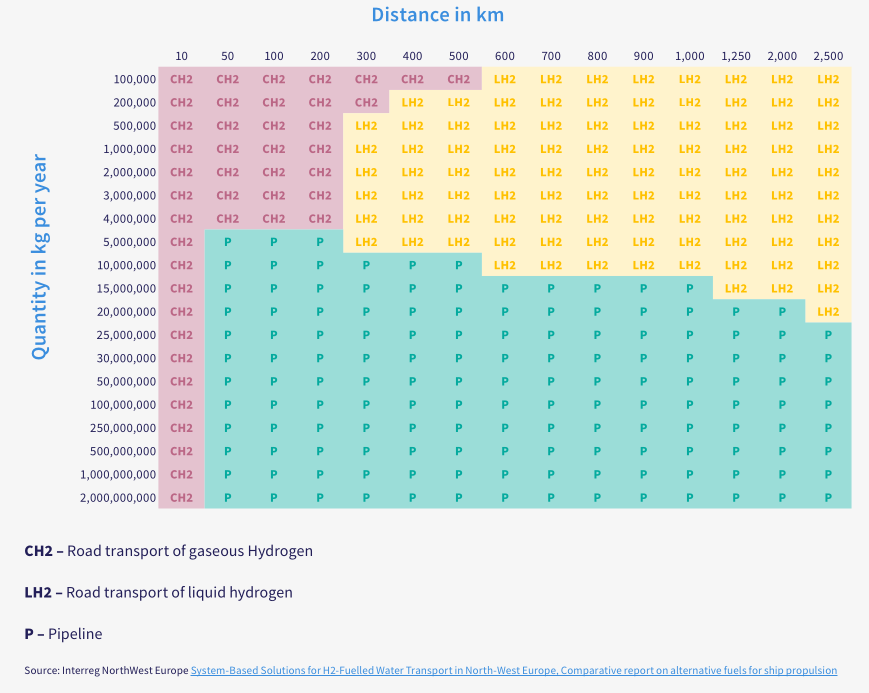
    Hydrogen transportation and storage options for maritime applications - comparing liquid hydrogen, compressed hydrogen, and hydrogen carriers
    Hydrogen transportation and storage pathways for maritime use. Source: Lloyd’s Register, Fuel for Thought: Hydrogen

    Technology Readiness: Viable but Maturing

    Hydrogen propulsion is technically viable today through two primary pathways:

    Internal Combustion Engines (ICE)

    • Efficiency: 40-45% typical
    • Advantages: Lower capital cost, proven marine engine platforms available
    • Challenges: NOx emissions require selective catalytic reduction (SCR), less efficient than fuel cells
    • Best suited for: Higher power applications, vessels with existing ICE experience

    Fuel Cells

    • Efficiency: 50-60% typical (system level)
    • Advantages: Higher efficiency, zero NOx emissions, quieter operation
    • Challenges: Higher capital cost, less operational experience in marine applications, limited power density for larger vessels
    • Best suited for: Ferries, short-sea vessels, auxiliary power applications

    Beyond Technology: Investment Readiness

    Technology readiness alone is not enough. The report correctly identifies that investment readiness and community readiness now matter just as much. This means:

    • Access to green financing and subsidy programs
    • Port authority support and regulatory alignment
    • Crew training infrastructure and operational protocols
    • Public acceptance and stakeholder engagement

    The Real Role of Hydrogen in Shipping

    Hydrogen will not replace diesel everywhere—and it shouldn’t. Its real strategic value lies in three areas:

    1. Enabling zero-emission vessels for specific applications: Short-sea routes, ferries, and offshore support vessels where bunkering frequency aligns with operational patterns
    2. Acting as a gateway fuel: Experience with hydrogen fuel systems, cryogenic storage, and safety protocols translates directly to ammonia and other hydrogen carriers
    3. Supporting the e-fuel ecosystem: Hydrogen is the feedstock for all synthetic fuels; maritime hydrogen adoption helps build production infrastructure for the broader transition

    For deep-sea shipping, hydrogen’s volumetric limitations make it less practical than hydrogen-derived fuels like ammonia or e-methanol. But for coastal and regional shipping, hydrogen offers a viable pathway to zero-emission operations today—not decades from now.

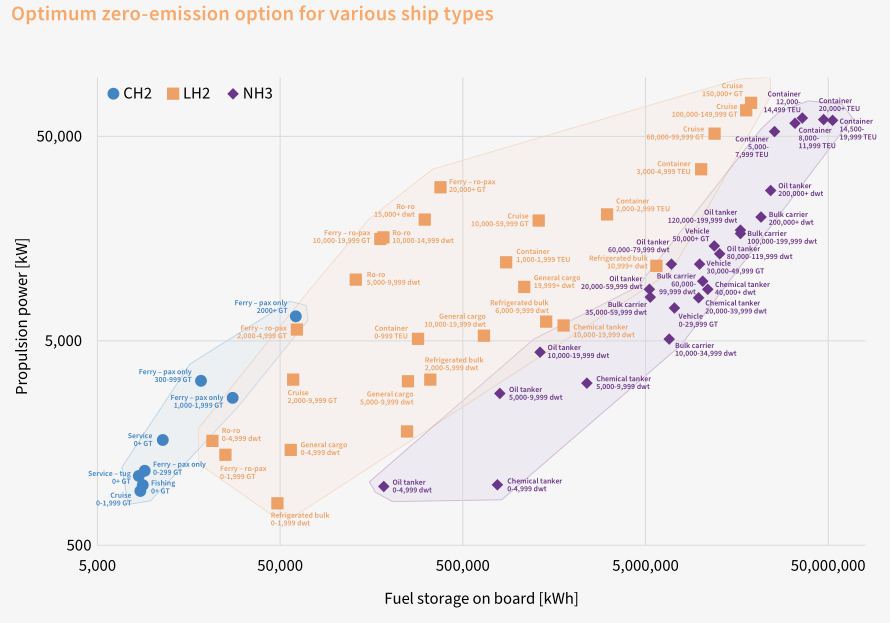
    Hydrogen fuel options mapped to different vessel types - ferries, offshore support, short-sea shipping, and deep-sea vessels
    Hydrogen applicability across different vessel types and operational profiles. Source: Lloyd’s Register, Fuel for Thought: Hydrogen

    Practical Takeaways for the Industry

    For Shipowners

    • Hydrogen is viable for specific routes and vessel types—assess it honestly against your operational profile
    • Engage early with classification societies to understand approval pathways
    • Factor in lifecycle costs including bunkering infrastructure and fuel certification
    • Explore available subsidies and financing programs; they significantly improve economics

    For Designers and Yards

    • Prioritize volumetric efficiency in tank arrangement and insulation design
    • Design for operational flexibility; dual-fuel or fuel-agnostic systems provide risk mitigation
    • Invest in hazard analysis expertise; safety case quality determines approval timeline
    • Consider boil-off gas management as integral to propulsion design, not an afterthought

    For Policymakers

    • Bunkering infrastructure requires coordinated support across maritime clusters
    • Certification and traceability of hydrogen production must be streamlined for regulatory compliance
    • Crew training standards need urgent development to support fleet growth
    • Policy stability matters—stop-start subsidies undermine investment confidence

    Final Thought: Viable, Advancing, Demanding

    Hydrogen is viable. It is advancing fast—faster than many expected even two years ago. But it demands discipline in design, honesty in lifecycle accounting, and patience in scaling infrastructure.

    Lloyd’s Register’s report cuts through the noise to deliver engineering reality. For shipowners and designers, hydrogen is no longer hypothetical. It is a strategic option that must be understood properly—not oversold, not dismissed, but evaluated with clear-eyed technical and commercial rigor.

    The question is no longer “Can we use hydrogen?” but “Where, when, and how does hydrogen make sense for our fleet?”

    That shift in perspective—from possibility to planning—is the real marker of how far the hydrogen transition has come.

    Related Resources on HydrogenShipbuilding.com

    Explore our comprehensive resources to understand hydrogen’s role in shipping:

    Sources & References

    • Lloyd’s Register (2024). Fuel for Thought: Hydrogen. Comprehensive assessment of hydrogen as marine fuel.
    • International Maritime Organization (IMO). Development of interim guidelines for hydrogen fuel systems (expected 2026).
    • FuelEU Maritime Regulation (EU) 2023/1805. Well-to-wake emissions accounting for alternative fuels.
    • International Organization for Standardization (ISO). Ongoing development of hydrogen bunkering standards.
    • Various industry reports on green hydrogen production costs and infrastructure development timelines.
  • European Study Reveals Best Ways to Transport Hydrogen

    The European Commission’s Joint Research Centre has published a comprehensive analysis comparing the costs and environmental impacts of transporting hydrogen across Europe. The study evaluated five delivery methods—compressed hydrogen, liquid hydrogen, ammonia, methanol, and liquid organic hydrogen carriers (LOHC)—transporting renewable hydrogen from Portugal to the Netherlands. The findings provide crucial guidance for Europe’s ambitious target of importing 10 million tonnes of renewable hydrogen annually by 2030.

    The Challenge: Moving Hydrogen Across Europe

    Europe’s hydrogen strategy hinges on a fundamental question: how do we transport large quantities of renewable hydrogen from production sites with abundant renewable energy to industrial demand centers? The EU’s REPowerEU initiative targets producing 10 million tonnes domestically and importing another 10 million tonnes of renewable hydrogen by 2030. This requires determining not just whether long-distance hydrogen transport is viable, but which methods offer the best balance of cost and environmental performance.

    To answer these questions, researchers at the Joint Research Centre conducted both a techno-economic assessment (TEA) and life cycle assessment (LCA) of hydrogen delivery chains. The study stands out for its comprehensive approach—most existing research focuses solely on costs or greenhouse gas emissions, neglecting broader environmental and social impacts.

    The Study Design

    The analysis examined a case study route from Portugal to the Netherlands (2,500 km), representing typical intra-European hydrogen corridors. A sensitivity analysis also considered longer distances (10,000 km) representing routes from the Persian Gulf via the Suez Canal. The assessment assumed delivery of 1 million tonnes of hydrogen annually post-2030.

    Five hydrogen carriers were compared:

    • Compressed hydrogen (C-H2) – Stored at 250 bar for shipping or 70 bar for pipelines
    • Liquid hydrogen (L-H2) – Cooled to -253°C for transport
    • Ammonia (NH3) – Synthesized from hydrogen and nitrogen
    • Methanol (MeOH) – Produced by combining hydrogen with CO2 from direct air capture
    • Liquid Organic Hydrogen Carrier (LOHC) – Using dibenzyltoluene as the carrier molecule

    All hydrogen was assumed to be produced via renewable electrolysis powered by photovoltaic electricity in Portugal (20 g CO2e/kWh), while processes at the delivery site used the projected 2030 Netherlands grid mix. Transportation by ship was modeled using biodiesel fuel, as large-scale hydrogen-powered vessels are unlikely by 2030.

    Key Findings: Winners and Losers

    The study’s conclusions were clear: shipping liquid hydrogen and transporting compressed hydrogen via pipeline emerged as the most cost-effective and environmentally sustainable options for long-distance delivery within Europe.

    Cost Analysis

    For the reference case (2,500 km), importing renewable hydrogen was generally more economical than on-site production using local renewable electricity, with one notable exception: the LOHC pathway proved more expensive than local production. Compressed hydrogen via pipeline and liquid hydrogen by ship offered the best economics, particularly where existing natural gas pipelines could be repurposed.

    As distance increased to 10,000 km, liquid hydrogen maintained its cost advantage, while compressed hydrogen became less attractive due to the increased number of vessels and fuel required for transport. Among chemical carriers, ammonia proved more economical than local production even over longer distances, while LOHC showed comparable costs and methanol remained the most expensive option.

    Environmental Performance

    On-site hydrogen production using renewable electricity at the delivery location remained the most environmentally sustainable option overall. However, when affordable renewable sources aren’t accessible at the delivery site, liquid hydrogen by ship and compressed hydrogen by pipeline proved most favorable among import options.

    The study assessed 16 environmental impact categories using the European Commission’s Environmental Footprint method, finding that resource use, climate change, and water use contributed most to overall environmental impact. Key insights included:

    • Chemical carriers face conversion penalties – Ammonia, LOHC, and methanol incurred higher costs and environmental impacts due to energy and materials required for “packing” (converting hydrogen to the carrier) and “unpacking” (reconverting to hydrogen)
    • Direct air capture is energy-intensive – Methanol’s packing stage proved particularly detrimental due to the high energy demands of capturing CO2 from the atmosphere
    • Dehydrogenation drives impacts – For ammonia and LOHC, the main environmental drawback was the additional energy required at the delivery site to extract hydrogen from the carrier
    • Transportation impact is relatively small – The transport stage itself had negligible environmental impact for most pathways, with compressed hydrogen being the exception (accounting for 27% of overall climate impact due to large shipping volumes)
    • PV panel production matters – Chemical carriers require additional renewable electricity at the production site, necessitating more solar panels. Given the significant environmental burden of manufacturing photovoltaic panels, this substantially increases overall impact

    The Global Warming Perspective

    When analysis focused solely on greenhouse gas emissions, compressed hydrogen and liquid hydrogen consistently showed the lowest carbon intensity. The study found climate impacts ranging from 1.88 kg CO2e per kg H2 delivered for compressed hydrogen by ship to 3.33 kg CO2e per kg H2 for methanol by pipeline over 2,500 km.

    An important finding: hydrogen leakage during transport partially offsets the climate benefits of shipping hydrogen in liquid or compressed form. Current loss estimates for liquid hydrogen (1.6% during liquefaction, 0.21% during storage, 0.2% per day during transport) are considerably higher than for chemical carriers, though these are expected to decrease. The study incorporated the latest research showing hydrogen has a global warming potential of 11.6 kg CO2e per kg H2 over a 100-year timeframe.

    Why Chemical Carriers Underperform

    The research reveals a consistent pattern: while chemical carriers like ammonia, methanol, and LOHC offer advantages in terms of using existing infrastructure and established handling protocols, they face fundamental thermodynamic challenges.

    Converting hydrogen into these carriers and back again requires significant energy input. For example:

    • Ammonia synthesis requires nitrogen extraction from air and energy-intensive Haber-Bosch processing, followed by energy-intensive cracking at the delivery site
    • Methanol production demands CO2 capture (via direct air capture in this study to maintain carbon neutrality) plus synthesis energy, with dehydrogenation required at delivery
    • LOHC hydrogenation and dehydrogenation both require substantial heat input, with the dehydrogenation step being particularly energy-intensive

    This additional energy typically requires more renewable electricity generation capacity at the production site—meaning more solar panels, which carry their own manufacturing environmental burden. When processes at the delivery site rely on grid electricity (which in 2030 will still have fossil fuel components), this further increases the environmental footprint.

    Literature Context and Validation

    The study’s literature review revealed significant gaps in existing research. Of 334 papers on hydrogen delivery costs published since 2015, only 34 addressed life cycle assessment and 44 covered greenhouse gas emissions. Just 8 studies included both cost and environmental analysis.

    The JRC findings align with most existing literature identifying compressed and liquid hydrogen as environmentally favorable options. However, comparisons across studies remain challenging due to varying assumptions about transport distance, hydrogen volumes, technology maturity, and infrastructure availability. Cost estimates for identical pathways can vary by factors of 2-3x depending on these assumptions.

    Why This Matters

    Why This Matters

    For Policymakers: Europe’s hydrogen import targets require immediate infrastructure decisions. This research provides evidence-based guidance: prioritize liquid hydrogen shipping and compressed hydrogen pipelines while improving efficiency of conversion technologies for chemical carriers.

    For Industry: Shipping companies and infrastructure developers can focus investment on the two most promising pathways. The study also highlights that repurposing existing natural gas pipelines for compressed hydrogen offers significant cost advantages.

    For the Environment: The comprehensive assessment reveals that seemingly “clean” hydrogen pathways can have hidden environmental costs in manufacturing solar panels, water consumption in water-scarce regions, and materials extraction. Multi-criteria assessments are essential to avoid shifting environmental burdens from one category to another.

    For Maritime Decarbonization: Liquid hydrogen emerges as a viable marine fuel pathway, particularly relevant for the shipping vessels themselves. The study’s finding that shipping with hydrogen-derived fuels could reduce transport-phase GHG emissions by up to 15% suggests a self-reinforcing benefit as the hydrogen economy scales.

    Limitations and Future Research

    The authors acknowledge several limitations that warrant consideration:

    • Geographic specificity – Results are specific to the Portugal-Netherlands corridor; different regions with varying renewable resources, grid mixes, and existing infrastructure may show different optimal pathways
    • Technology maturity uncertainty – Many technologies assessed are still in early development stages, with significant uncertainty around future costs and performance
    • Forward-looking projections – The study assumes post-2030 deployment with optimistic projections for renewable electricity GHG intensity (20 g CO2e/kWh), considerably lower than current state-of-the-art
    • Social impacts excluded – The analysis doesn’t address safety considerations, training costs, or societal acceptance—factors that may favor established chemical carriers despite higher environmental costs
    • Limited environmental models – Some environmental impact categories have low robustness in their assessment methodologies

    The JRC has since conducted separate social life cycle assessments, finding that local hydrogen production in Northern Europe outperforms import-based scenarios across most social indicators due to simpler value chains and reduced labor intensity.

    Policy Recommendations

    Based on the findings, the researchers recommend:

    1. Promote multi-criteria assessments to avoid shifting impacts from one sustainability dimension to another
    2. Expand regulatory scope – Mechanisms like the Carbon Border Adjustment Mechanism (CBAM) should encompass the entire hydrogen delivery chain and consider environmental categories beyond climate change
    3. Prioritize infrastructure development for liquid hydrogen shipping and compressed hydrogen pipelines while continuing R&D on conversion efficiency improvements
    4. Enhance data quality – Improve reliability and transparency of life cycle inventory data for hydrogen technologies
    5. Refine assessment methodologies – Emphasize underrepresented environmental categories and develop robust social impact indicators
    6. Consider temporal trade-offs – Substantial investments in ammonia infrastructure may delay development of more efficient direct hydrogen transport systems

    The Bottom Line

    For Europe’s hydrogen economy to achieve its dual goals of cost-effectiveness and environmental sustainability, the path forward is clear: liquid hydrogen shipping and compressed hydrogen pipelines should be the primary focus for long-distance transport infrastructure investment. Chemical carriers like ammonia, methanol, and LOHC have roles to play—particularly where existing infrastructure can be leveraged—but their fundamental conversion inefficiencies mean they cannot match the economics and environmental performance of direct hydrogen transport.

    The study also underscores a crucial insight: the most economically favorable options tend to be environmentally preferable as well. This alignment suggests that market forces, if properly structured through mechanisms like carbon pricing and environmental standards, can drive deployment of the most sustainable hydrogen delivery pathways.

    As Europe moves toward its 2030 target of importing 10 million tonnes of renewable hydrogen, this research provides the evidence base needed for informed infrastructure investment decisions worth tens of billions of euros.

    Specifications at a Glance

    Carrier Cost (€/kg H2) at 2,500 km Climate Impact (kg CO2e/kg H2) Key Advantage Main Challenge
    C-H2 Pipeline ~4.0 2.22 Existing pipeline infrastructure can be repurposed Limited to pipeline-connected regions
    L-H2 Ship ~4.8 1.89 Best cost-environment balance for shipping Boil-off losses, cryogenic handling
    NH3 ~7.0 2.84 Existing handling infrastructure and experience Energy-intensive cracking at delivery
    LOHC ~6.5 2.84-3.33 Ambient temperature/pressure handling Very high dehydrogenation energy demand
    MeOH ~8.0 2.84-3.33 Liquid at ambient conditions Direct air capture energy intensity
    On-site Production ~6.8 0.50 No transport needed, lowest environmental impact Requires local renewable electricity availability

    Note: Values are approximate and vary with specific assumptions. Costs shown are levelized costs including production, packing, transport, unpacking, and delivery.

    Sources

    • Arrigoni, A., D’Agostini, T., Dolci, F., & Weidner, E. (2025). “Techno-economic and life-cycle assessment comparisons of hydrogen delivery options.” Frontiers in Energy, 19(6): 1129-1142. DOI: 10.1007/s11708-025-1041-1
    • Ortiz Cebolla, R., Dolci, F., & Weidner, E. (2022). “Assessment of hydrogen delivery options: Feasibility of transport of green hydrogen within Europe.” Joint Research Centre, European Commission.
    • Arrigoni, A., Dolci, F., Ortiz Cebolla, R., et al. (2024). “Environmental life cycle assessment (LCA) comparison of hydrogen delivery options within Europe.” Joint Research Centre, European Commission.
    • European Commission. (2020). “A Hydrogen Strategy for a Climate-Neutral Europe.”
    • European Commission. (2022). “REPowerEU: Joint European Action for More Affordable, Secure and Sustainable Energy.”

  • Japan’s Hydrogen Engine Consortium Achieves World’s First Marine H₂ Engine Land-Based Operation

    Japan’s Hydrogen Engine Consortium Achieves World’s First Marine H₂ Engine Land-Based Operation | HydrogenShipbuilding

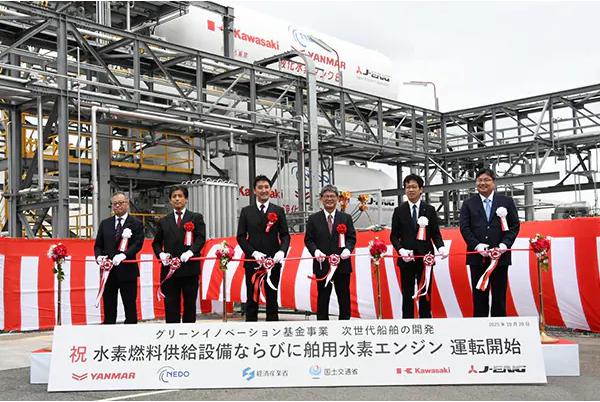
    On October 28, 2025, Kawasaki Heavy Industries, Yanmar Power Solutions, and Japan Engine Corporation announced the successful completion of the world’s first land-based operation of marine hydrogen engines. The demonstration took place at Japan Engine’s headquarters factory in Japan, utilizing a newly installed liquefied hydrogen fuel supply system manufactured by Kawasaki.

    The Three Engines: A Full Power Range

    What makes this project particularly significant is the coordinated development of engines covering the full spectrum of marine propulsion needs—from auxiliary power to main propulsion:

    Manufacturer Type Model Engine Speed Rated Output
    Kawasaki Heavy Industries Medium-speed 4-stroke 8L30KG-HDF 720 min⁻¹ 2,600 kW
    Yanmar Power Solutions Medium-speed 4-stroke 6EY22ALDF-H 900 min⁻¹ 800 kW
    Japan Engine Corporation Low-speed 2-stroke 6UEC35LSGH Max. 167 min⁻¹ Max. 5,610 kW

    All three engines feature dual-fuel capability, allowing them to switch between hydrogen and diesel fuel. This redundancy is critical for early adopters concerned about H₂ supply reliability. Kawasaki and Yanmar have already demonstrated stable hydrogen combustion at rated output in their medium-speed four-stroke engines. Japan Engine’s low-speed two-stroke engine—the workhorse of deep-sea shipping—is scheduled for first operation in Spring 2026.

    The LH₂ Fuel Supply System

    Kawasaki’s liquefied hydrogen fuel supply system (MHFS) is the backbone of this demonstration. The system stores and gasifies liquid hydrogen, supplying it at both high and low pressure to accommodate the different engine types:

    • Low-speed two-stroke main propulsion engines (J-ENG)
    • Four-stroke auxiliary engines (Yanmar)
    • Four-stroke main generator engines for electric propulsion ships (Kawasaki)

    The ability to serve multiple engine configurations from a single fuel system is a practical engineering solution that could simplify future vessel designs.

    Funding: Japan’s JPY 2 Trillion Green Innovation Fund

    This project is part of NEDO’s Green Innovation Fund Projects under the “Next-Generation Ship Development” initiative, specifically the “Development of Marine Hydrogen Engine and MHFS” program.

    Green Innovation Fund Details

    • Total Fund Size: JPY 2 trillion (~US$13 billion)
    • Additional Allocations: JPY 300 billion (FY2022) + JPY 456.4 billion (FY2023)
    • Managing Organization: NEDO (New Energy and Industrial Technology Development Organization)
    • Government Backing: METI (Ministry of Economy, Trade and Industry)

    Japan declared its carbon neutrality goal in October 2020, and this fund represents one of the most substantial national investments in maritime decarbonization globally. For context, this dwarfs even the EU Innovation Fund’s maritime allocations.

    Industry Context: Japan’s Hydrogen Shipping Push

    This consortium milestone comes amid a flurry of hydrogen activity in Japan:

    • April 2025: Yanmar Power Technology received DNV Approval in Principle (AiP) for its GH320FC maritime hydrogen fuel cell system—designed for coastal passenger ferries, inland waterway cargo vessels, and port service vessels
    • March 2025: Tsuneishi Shipbuilding launched Japan’s first hydrogen dual-fuel tug with high-power internal combustion engine and 250 kg compressed H₂ storage (see our Ships page)
    • January 2025: Yanmar received government approval for its hydrogen-fueled engines and fuel cell systems production plan under the “Zero Emission Ship Construction Promotion Project”

    Japan is pursuing a dual-track approach: fuel cells for harbor and coastal applications, and hydrogen ICE for larger vessels requiring higher power outputs. The consortium’s engines—ranging from 800 kW to 5,610 kW—fill a gap that fuel cells cannot yet cost-effectively address.

    Hydrogen ICE vs. Fuel Cells: The Engineering Trade-Off

    From a naval architect’s perspective, the choice between hydrogen internal combustion engines and fuel cells involves significant trade-offs:

    Hydrogen ICE Advantages:

    • Lower capital cost than fuel cells at equivalent power
    • Familiar technology for crews and shipyards
    • Dual-fuel capability provides operational flexibility
    • Better suited for high-power applications (>2 MW)

    Hydrogen ICE Limitations:

    • Lower efficiency than fuel cells (~44% peak vs. ~50-60% for PEMFCs)
    • Still produces NOₓ emissions (though no CO₂)
    • Requires pilot fuel in dual-fuel mode, reducing emissions benefit by up to 12.5%

    The consortium’s approach—starting with dual-fuel engines that can later run on pure hydrogen as infrastructure matures—represents a pragmatic path forward.

    Challenges Ahead

    ⚠️ BOTTLENECK: LH₂ Supply Infrastructure

    While the land-based demonstrations are complete, the real test will be onboard operation. Key challenges remain:

    • Liquefied hydrogen bunkering infrastructure is virtually non-existent for marine applications
    • Cryogenic storage at -253°C requires specialized tank systems with boil-off management
    • Classification rules for hydrogen-fueled vessels are still evolving
    • Crew training for H₂ handling remains a significant undertaking

    The consortium will need to work closely with shipowners and shipyards to address these practical considerations before commercial deployment.

    Next Steps: From Shore to Sea

    The consortium has outlined a clear roadmap:

    1. Land-based demonstrations (Completed October 2025)
    2. 🔄 J-ENG two-stroke engine operation (Spring 2026)
    3. 📋 Onboard trials with shipowners and shipyards (Timeline TBD)
    4. 🚢 Commercial implementation (Target: Before 2050)

    The involvement of all three major Japanese marine engine manufacturers—unified under NEDO coordination—positions Japan to become a leader in marine hydrogen ICE technology, complementing fuel cell developments from the same companies.

    What This Means for Ship Operators

    For operators considering hydrogen propulsion, this milestone offers several takeaways:

    • Dual-fuel hydrogen engines will be available across a range of power outputs suitable for everything from auxiliary generators to main propulsion
    • Japanese manufacturers are positioning themselves as credible suppliers alongside European competitors like MAN and Wärtsilä
    • The LH₂ fuel system validated here could become a template for future vessel designs
    • Government support through programs like the Green Innovation Fund reduces technology risk for early adopters

    As the consortium moves toward onboard trials, the maritime industry will be watching closely. Japan has made its bet on hydrogen—both fuel cells and internal combustion—and this demonstration brings commercial viability one step closer to reality.

    Sources

    • Yanmar Holdings Co., Ltd. Press Release (October 28, 2025)
    • Japan Engine Corporation Press Release (October 28, 2025)
    • NEDO Green Innovation Fund Projects
    • Ship Technology (October 29, 2025)
    • Marine Link (October 28, 2025)
  • Samskip selects Norwegian Hydrogen as preferred supplier of liquid green hydrogen

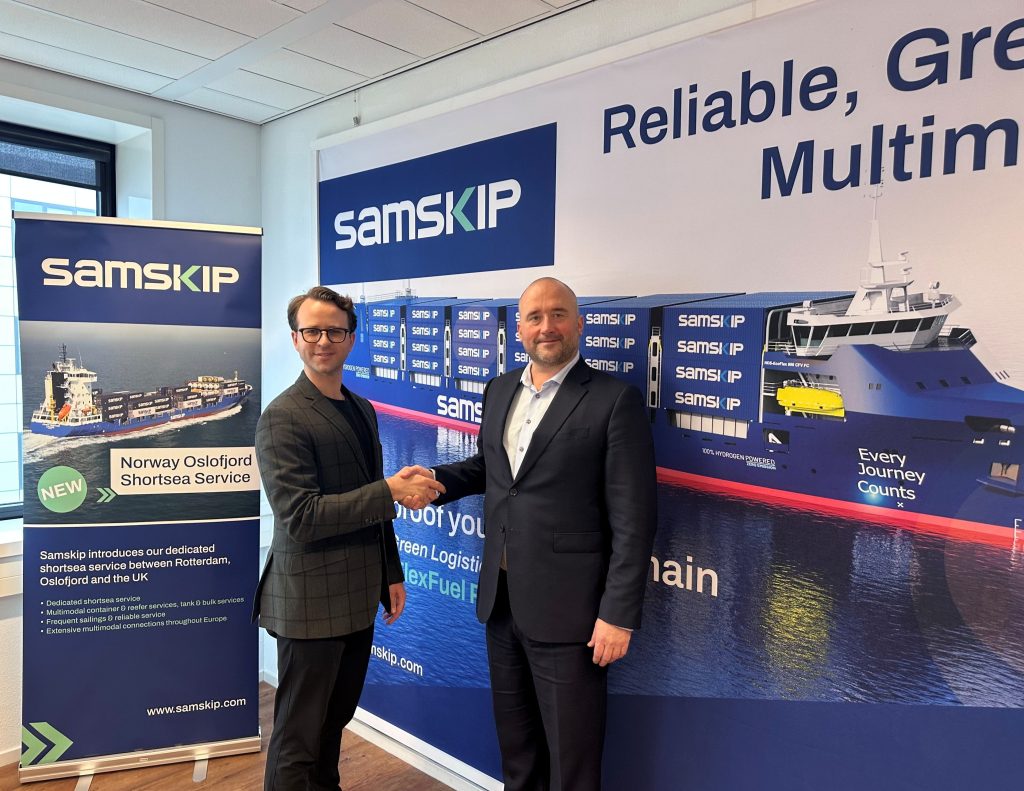
    European logistics company Samskip has selected Norwegian Hydrogen as its preferred supplier of liquid green hydrogen for two SeaShuttle container vessels currently under construction. The vessels will operate the world’s first hydrogen-powered container shipping route between Rotterdam and Oslo, breaking the classic “chicken-and-egg” deadlock that has constrained the hydrogen economy. With Norwegian Hydrogen’s Rjukan plant securing EUR 31.5 million from the EU Innovation Fund and NOK 100 million in domestic support, hydrogen deliveries are expected to begin in 2028.

    World’s First Hydrogen Container Ships Find Their Fuel Source

    The Memorandum of Understanding signed on December 5, 2025, resolves a critical uncertainty for Samskip’s pioneering SeaShuttle vessels: where the hydrogen will come from. While shipbuilders can construct hydrogen-powered vessels and classification societies can certify them, the infrastructure for producing, liquefying, storing, and bunkering hydrogen at scale has lagged behind ship development. This agreement synchronizes vessel delivery with fuel supply readiness—both targeting operational capability by 2028.

    Samskip’s investment reflects its ambitious climate commitments. The company recently achieved verification of its “Net-Zero by 2040” target from the Science-Based Targets initiative and received the EcoVadis Platinum medal, ranking in the top 1% for sustainability performance in 2024. The SeaShuttle hydrogen conversion, supported by a grant from Norway’s Enova Fund, demonstrates the company’s willingness to accept first-mover risks to achieve deep decarbonization.

    The Rotterdam-Oslo Route

    The SeaShuttle vessels will operate Samskip’s established Rotterdam-Oslo service, a strategic choice for several reasons. This route exemplifies short-sea shipping—distances where hydrogen’s energy density disadvantages matter less than for transoceanic voyages. The approximately 1,200 km route allows for manageable tank sizes and regular refueling opportunities.

    Both Rotterdam and Oslo offer favorable conditions for hydrogen infrastructure development. Rotterdam, Europe’s largest port, has committed to becoming a hydrogen import hub, with multiple projects underway. Oslo, as Norway’s capital and a center of green shipping initiatives, provides supportive regulatory frameworks and public awareness. The route’s predictable schedule—critical for early-stage technology validation—enables systematic data collection on hydrogen consumption, refueling procedures, and operational costs.

    Container shipping on this route also serves diverse commercial customers, demonstrating hydrogen’s viability for mainstream logistics rather than niche applications. Success here could accelerate adoption across Samskip’s broader European network.

    Norwegian Hydrogen’s Rjukan Facility

    The hydrogen supply will come from Norwegian Hydrogen’s liquid hydrogen production plant in Rjukan, Norway—a location with deep historical connections to industrial chemistry and, ironically, to early 20th-century hydrogen production for ammonia synthesis.

    Strategic Location

    Rjukan sits in Telemark county, a region with abundant hydroelectric power resources. The plant will operate under a long-term power purchase agreement with Tinn Energi & Fiber, ensuring access to renewable electricity—the fundamental requirement for green hydrogen production. Norway’s hydroelectric generation, with exceptionally low carbon intensity (typically <10 g CO2e/kWh), provides one of the world's cleanest electricity sources for electrolysis.

    The required grid connection has been secured, and municipal authorities have approved the zoning plan. Norwegian Hydrogen reports being in final phases of selecting suppliers for key equipment, components, and services, suggesting construction will commence shortly.

    Funding Structure

    The project has assembled substantial financial support from multiple sources:

    • EUR 31.5 million from the 2025 EU Innovation Fund – Supporting establishment of the complete value chain for production, distribution, and bunkering of liquefied hydrogen
    • EUR 13.2 million from the EU Hydrogen Auction – Covering operating costs, reducing delivered hydrogen prices during the early commercial phase
    • NOK 100 million (~EUR 8.5 million) from Innovation Norway – Combination of grants and green loans for project development

    This funding diversification—combining capital grants, operational subsidies, and concessional financing—addresses different risk categories. Capital grants reduce upfront investment requirements, operational subsidies enable competitive pricing during market development, and green loans provide flexible financing for working capital and contingencies.

    The total support package approaches EUR 53 million (approximately USD 58 million), representing substantial public investment in establishing Norway’s first complete maritime liquid hydrogen value chain.

    Production Capacity and Technology

    While Norwegian Hydrogen hasn’t disclosed precise production capacity, the project is described as “right-sized” for early adopters. Industry sources suggest the facility will likely produce 5-10 tonnes of liquid hydrogen per day initially, sufficient to supply multiple vessels including the two Samskip SeaShuttles while allowing for additional customers in maritime, industrial, and other sectors.

    Hydrogen production will use water electrolysis powered by renewable electricity. The plant will include liquefaction capability—a critical and energy-intensive step consuming approximately 30-35% of hydrogen’s energy content but essential for marine applications where volumetric energy density matters. On-site liquefaction eliminates transportation logistics for gaseous hydrogen and enables direct loading onto vessels.

    Breaking the Chicken-and-Egg Deadlock

    The agreement addresses what Norwegian Hydrogen CEO Jens Berge calls the hydrogen economy’s “classic chicken-and-egg dilemma”: lack of demand hinders investment in production, while lack of supply discourages demand creation.

    Samskip’s commitment provides Norwegian Hydrogen with demand certainty, enabling final investment decisions. Conversely, Norwegian Hydrogen’s secured funding and advanced project status gives Samskip confidence their vessels won’t face fuel supply disruptions. The MoU formalizes this mutual dependency, allowing both parties to proceed with substantial capital commitments.

    This dynamic mirrors successful infrastructure transitions historically. Natural gas vehicle adoption accelerated when fleet operators and fuel suppliers coordinated investments. Electric vehicle deployment required simultaneous buildout of charging networks and vehicle production. Hydrogen shipping faces similar coordination challenges, but at higher stakes given the specialized infrastructure requirements.

    Why This Matters

    Why This Matters

    For Short-Sea Shipping Decarbonization: Container shipping accounts for significant European maritime emissions. If Samskip successfully demonstrates hydrogen-powered container operations, it validates the technology for dozens of similar routes across Europe. The North Sea, Baltic Sea, and Mediterranean all feature short-sea routes where hydrogen could compete effectively with diesel or LNG.

    For Hydrogen Infrastructure Development: The Rjukan facility creates a template for maritime hydrogen production combining optimal renewable electricity access, liquefaction capability, and multi-modal distribution. Success here could accelerate similar projects in other hydropower-rich regions: Canada, Iceland, Scotland, New Zealand, or South America’s Patagonia region.

    For First-Mover Advantage: Samskip’s commitment positions the company to capture premium pricing from environmentally conscious shippers, potentially securing long-term contracts with customers facing supply chain emission reduction mandates. As EU carbon regulations tighten, zero-emission shipping capacity will command premium rates.

    For Risk Mitigation Strategy: Securing a preferred supplier relationship, rather than depending on spot markets, protects Samskip from potential hydrogen price volatility and supply constraints as the market develops. The MoU likely includes provisions ensuring supply continuity and price certainty.

    For Norway’s Hydrogen Strategy: This project anchors Norway’s position as a European hydrogen exporter, leveraging abundant renewable electricity and existing maritime expertise. Success could spawn additional facilities, creating an export industry complementing Norway’s traditional oil and gas sector as it declines.

    Broader Implications

    This agreement exists within a broader European hydrogen ecosystem rapidly taking shape:

    • Multiple shipping companies are developing hydrogen vessel projects: ferry operators in Scandinavia, offshore service vessels in Norway, and passenger vessels across Europe
    • Port authorities in Rotterdam, Oslo, Hamburg, Antwerp, and elsewhere are planning hydrogen infrastructure as part of decarbonization strategies
    • Equipment manufacturers are scaling production of electrolyzers, fuel cells, cryogenic systems, and bunkering equipment
    • Energy companies are developing renewable electricity projects explicitly dedicated to hydrogen production
    • Classification societies have published rules and guidelines for hydrogen-fueled vessels, enabling design approvals

    The Samskip-Norwegian Hydrogen agreement demonstrates that these parallel developments are converging toward operational systems. Each successful project reduces risk perceptions, generates operational data, and builds confidence for subsequent investments.

    Quotes from Leadership

    “Our partnership with Norwegian Hydrogen marks an important step on our journey towards Net-Zero emissions by 2040,” stated Ólafur Orri Ólafsson, CEO of Samskip. “Hydrogen is a critical enabler for deep decarbonization in short-sea shipping, and Norwegian Hydrogen has demonstrated the capability and commitment needed to support our ambition. Together, we are not only preparing the energy supply for our SeaShuttle vessels, we are also helping accelerate the transition to sustainable logistics across Europe.”

    “We are deeply grateful for Samskip’s support and first-mover determination, leading the way in decarbonising short-sea container shipping,” responded Jens Berge, CEO of Norwegian Hydrogen. “It is reassuring to see that our efforts to create a project that meets Samskip’s requirements are now yielding tangible results, enabling Samskip to proceed exclusively with us from this point. Right-sized and with all critical elements in place, the Rjukan LH2 project is ideally positioned for delivery of liquid green hydrogen to early adopters within maritime, industry, and other sectors, covering a large geographical area at a highly attractive price point.”

    Project Summary

    Element Details
    Customer Samskip (European logistics company)
    Supplier Norwegian Hydrogen AS
    Vessels Two SeaShuttle container vessels (under construction)
    Route Rotterdam, Netherlands ↔ Oslo, Norway (~1,200 km)
    Fuel Type Liquid green hydrogen (LH2) from renewable electrolysis
    Production Site Rjukan, Telemark, Norway
    Power Source Norwegian hydroelectricity (Tinn Energi & Fiber)
    EU Innovation Fund EUR 31.5 million (value chain development)
    EU Hydrogen Auction EUR 13.2 million (operating costs)
    Innovation Norway NOK 100 million (~EUR 8.5 million, grants + green loans)
    Norwegian Enova Fund Grant supporting vessel conversion (amount not disclosed)
    Expected Operations 2028
    Status MoU signed December 5, 2025; exclusive supplier relationship

    Looking Ahead

    The Samskip-Norwegian Hydrogen partnership represents more than two companies agreeing to a fuel supply contract. It demonstrates that the maritime hydrogen economy is transitioning from concept to implementation, with real vessels, real production facilities, and real commercial operations approaching.

    Success will depend on execution—building plants on schedule and budget, commissioning vessels successfully, establishing safe and efficient bunkering procedures, and demonstrating acceptable operational economics. But the fundamentals appear sound: strong corporate commitments backed by substantial public funding, favorable renewable electricity access, suitable routes for early adoption, and supportive regulatory frameworks.

    If the SeaShuttles operate successfully from 2028 onward, expect announcements of additional hydrogen container vessels, expansion of production capacity at Rjukan and other sites, and growing confidence among shipowners and fuel suppliers that hydrogen shipping has moved from possibility to reality.

    The chicken-and-egg deadlock is breaking. Now comes the harder part: proving it works.

    Sources

    • Norwegian Hydrogen AS. (2026). “Samskip moves forward with Norwegian Hydrogen as its preferred supplier of liquid green hydrogen.” Press release, January 7, 2026.
    • Norwegian Hydrogen AS. (2025). “More support for Rjukan liquid hydrogen project with EUR 31.5 million grant from EU Innovation Fund.” Press release, November 3, 2025.
    • Norwegian Hydrogen AS. (2025). “Double win for Norwegian Hydrogen at Rjukan with funding offers from both the EU Hydrogen Bank and Innovation Norway.” Press release, May 20, 2025.
    • Samskip corporate communications, December 2025.
  • Kawasaki Heavy Industries to Build World’s Largest Liquefied Hydrogen Carrier

    Kawasaki Heavy Industries has signed a contract with Japan Suiso Energy to construct the world’s largest liquefied hydrogen carrier, featuring a cargo capacity of 40,000 cubic meters. This vessel represents a 32-fold increase over the company’s pioneering Suiso Frontier, marking a critical transition from demonstration projects to commercial-scale hydrogen transport. Scheduled for ocean trials by 2030, the carrier will demonstrate the technical and economic feasibility of large-scale hydrogen shipping as Japan advances toward its carbon-neutral goals.

    Kawasaki's 40,000 m3 liquefied hydrogen carrier concept

    Source: Kawasaki Heavy Industries

    From Demonstration to Commercial Scale

    The leap from Kawasaki’s 1,250-cubic-meter Suiso Frontier—completed in 2021 as the world’s first liquefied hydrogen carrier—to this 40,000-cubic-meter vessel demonstrates the rapid progression of hydrogen shipping technology. This new carrier will be built at Kawasaki Heavy Industries’ Sakaide Works in Kagawa Prefecture as part of Japan’s New Energy and Industrial Technology Development Organization (NEDO) Green Innovation Fund Project.

    Japan Suiso Energy, serving as project operator for NEDO, aims to conduct comprehensive demonstrations of ship-to-shore loading and unloading operations by fiscal year 2030. The project will test operational performance, safety, durability, reliability, and crucially, economic feasibility for large-scale hydrogen transport—information essential for establishing commercial viability.

    Technical Innovation for Cryogenic Cargo

    Transporting liquefied hydrogen presents unique engineering challenges. At -253°C, liquid hydrogen requires specialized containment systems and handling procedures far more demanding than conventional cryogenic cargoes like LNG.

    Cargo Containment System

    The vessel’s cargo tanks total approximately 40,000 cubic meters and incorporate high-performance insulation systems designed to minimize boil-off gas generated by natural heat ingress. Managing boil-off is critical for long-distance transport—hydrogen’s extremely low boiling point means even minimal heat transfer causes evaporation. The insulation system must maintain cryogenic temperatures throughout voyages potentially lasting weeks.

    Unlike LNG carriers where boil-off rates of 0.10-0.15% per day are standard, liquid hydrogen faces steeper challenges. The Suiso Frontier demonstrated boil-off rates around 0.2-0.3% per day, and this larger vessel aims to improve on these figures through advanced vacuum-jacketed tank technology.

    Dual-Fuel Propulsion

    The carrier will feature a diesel and hydrogen-fueled electric propulsion system, combining hydrogen- and oil-based dual-fuel generator engines with conventional oil-fired generators. This hybrid approach offers operational flexibility while reducing carbon emissions.

    Significantly, boil-off gas from the cargo tanks can be compressed, heated, and reused as fuel for propulsion. This not only reduces CO2 emissions but also addresses the economic and environmental cost of venting hydrogen—a solution that transforms a liability into an asset. This capability is particularly relevant given hydrogen’s global warming potential (11.6 kg CO2e per kg H2 over 100 years), making venting environmentally undesirable.

    Cargo Handling Infrastructure

    The vessel will be equipped with a cargo handling system capable of loading and unloading large volumes of liquefied hydrogen using double-wall vacuum-jacketed piping. These transfer systems maintain extremely low temperatures during operations between shore facilities and onboard tanks, preventing heat ingress that would cause excessive boil-off.

    The carrier will operate in conjunction with a liquefied hydrogen terminal under construction at Ogishima in Kawasaki City, forming an integrated supply chain infrastructure for demonstration purposes.

    Optimized for Hydrogen’s Unique Properties

    Liquid hydrogen’s extremely low density—approximately 71 kg/m³ compared to LNG’s 450 kg/m³—fundamentally affects vessel design. The hull form and draft have been specifically optimized to reflect this characteristic, improving propulsion efficiency and reducing power requirements.

    This density difference means that for equivalent energy content, hydrogen requires significantly more volume than other marine fuels. The 40,000 m³ capacity translates to approximately 2,840 tonnes of liquid hydrogen—roughly equivalent in energy terms to 7,800 tonnes of LNG, yet requiring more than five times the volume.

    Safety and Risk Management

    Hydrogen’s wide flammability range (4-75% in air, compared to 5-15% for natural gas) and low ignition energy demand rigorous safety protocols. The vessel’s hydrogen fuel, supply, and cargo handling systems have undergone comprehensive risk assessment, with multiple safety measures incorporated to protect crew, environment, and vessel structure.

    ClassNK, the classification society, will oversee compliance with safety standards. The vessel will be registered in Japan, operating under Japanese maritime regulations for hydrogen transport—a regulatory framework still evolving as the technology matures.

    Specifications at a Glance

    • Length Overall: Approximately 250 meters
    • Molded Breadth: 35 meters
    • Fully Loaded Draft: 8.5 meters (summer)
    • Cargo Capacity: 40,000 cubic meters (~2,840 tonnes liquid hydrogen)
    • Service Speed: Approximately 18 knots
    • Propulsion: Diesel and hydrogen dual-fuel electric system
    • Cargo Containment: High-performance insulated cryogenic tanks
    • Classification: ClassNK
    • Flag: Japan
    • Builder: Kawasaki Heavy Industries, Sakaide Works
    • Expected Completion: By fiscal year 2030 (demonstration trials)

    Strategic Context: Japan’s Hydrogen Economy

    This carrier serves as a cornerstone for Japan’s hydrogen strategy, which anticipates significant global hydrogen demand in the 2030s. Japan has committed to achieving carbon neutrality by 2050 and views hydrogen as essential for decarbonizing power generation, mobility, and industrial sectors—applications where electrification faces technical or economic limitations.

    The vessel enables what Japan cannot produce domestically at sufficient scale: low-cost renewable hydrogen. By importing hydrogen produced using abundant renewable electricity from regions like Australia, the Middle East, or potentially Europe, Japan can access competitively priced clean energy despite limited domestic renewable resources.

    This strategy aligns with findings from recent European Commission research showing that shipping liquid hydrogen emerges as one of the most cost-effective and environmentally sustainable options for long-distance hydrogen transport, particularly compared to chemical carriers like ammonia or methanol which require energy-intensive conversion processes.

    Economic Viability Questions

    While technical feasibility has been demonstrated through the Suiso Frontier project, economic viability remains uncertain. Key cost drivers include:

    • Liquefaction costs: Consuming approximately 30-35% of hydrogen’s energy content
    • Specialized infrastructure: Cryogenic storage, handling equipment, and dedicated terminals
    • Boil-off losses: Even with improved insulation, some hydrogen will be lost
    • Vessel capital costs: Specialized materials and systems increase construction costs
    • Scale requirements: Economic efficiency improves dramatically with larger vessels and higher utilization

    The 2030 demonstration will provide critical data on these factors. Current estimates suggest delivered hydrogen costs could range from €4-6 per kilogram for long-distance shipping, depending on production costs, utilization rates, and infrastructure amortization.

    Why This Matters

    Why This Matters

    For Global Hydrogen Markets: This vessel demonstrates that liquid hydrogen shipping can scale to commercial volumes. The 40,000 m³ capacity—sufficient to transport approximately 2,840 tonnes per voyage—enables economically viable international trade. Multiple such vessels could deliver millions of tonnes annually, matching planned production and demand scenarios for the 2030s.

    For Maritime Decarbonization: The dual-fuel propulsion system showcasing hydrogen as a marine fuel validates one pathway for shipping’s own decarbonization. By 2030, this carrier will provide operational data on hydrogen’s performance, reliability, and safety as a marine fuel under commercial conditions—information crucial for wider adoption.

    For Energy Security: Countries lacking domestic renewable resources can access global hydrogen markets, diversifying energy supply and reducing dependence on fossil fuel imports. Japan’s investment in this infrastructure reflects a strategic bet on hydrogen as a pillar of future energy security.

    For Industrial Decarbonization: Heavy industries—steel, chemicals, cement—require high-temperature heat and chemical reducing agents that electricity cannot easily provide. Large-scale hydrogen imports make decarbonization of these sectors technically and economically feasible in regions without domestic production capacity.

    For Innovation Spillover: Technologies developed for liquid hydrogen shipping—ultra-high-performance insulation, cryogenic handling systems, dual-fuel engines—have applications across the broader cryogenic industry, from LNG to industrial gases.

    Challenges Ahead

    Despite this progress, significant hurdles remain:

    Infrastructure Development: Establishing a commercial hydrogen supply chain requires coordinated investment in production facilities, liquefaction plants, storage terminals, and distribution networks—a chicken-and-egg challenge requiring billions in capital before revenue flows.

    Cost Competitiveness: Hydrogen must compete with established energy carriers. Even with carbon pricing, delivered costs need to decline substantially to be economically attractive for most applications.

    Regulatory Framework: International regulations for hydrogen shipping remain under development. The International Maritime Organization (IMO) aims to finalize hydrogen-specific regulations by 2028, but gaps persist regarding classification, port state control, and emergency response protocols.

    Safety Perception: Public and industry acceptance of hydrogen transport through populated port areas requires demonstrating robust safety records and incident response capabilities.

    Scale-Up Timeline: Even successful 2030 demonstrations won’t immediately translate to commercial deployment. Building fleets, establishing supply chains, and achieving operational optimization will require years of additional investment and learning.

    Competitive Landscape

    Kawasaki’s leadership position faces potential competition. European shipbuilders are exploring similar technologies, and China has announced plans for large-scale hydrogen carriers. However, Kawasaki’s first-mover advantage—demonstrated through the Suiso Frontier—provides valuable operational experience and intellectual property.

    The vessel also competes with alternative hydrogen carriers. Ammonia shipping benefits from existing infrastructure and lower containment costs, though it requires energy-intensive conversion at both ends. LOHCs (Liquid Organic Hydrogen Carriers) offer ambient-temperature handling but face even higher conversion energy penalties. Compressed hydrogen pipelines remain competitive for shorter distances within continental regions.

    Recent European research suggests liquid hydrogen shipping and compressed hydrogen pipelines offer the best balance of cost and environmental performance for long-distance transport, supporting Kawasaki’s strategic direction.

    Timeline and Next Steps

    Construction at Sakaide Works will occur over the next several years, with ocean-going trials scheduled by fiscal year 2030. The demonstration phase will evaluate:

    • Loading and unloading procedures at commercial scale
    • Boil-off management during extended voyages
    • Dual-fuel propulsion system performance and reliability
    • Maintenance requirements and operational costs
    • Safety protocols and emergency procedures
    • Environmental performance including CO2 emissions reduction

    Success in these demonstrations could trigger orders for commercial vessels in the early 2030s, with full-scale deployment potentially beginning mid-decade. Japan Suiso Energy and NEDO will share findings with industry stakeholders to accelerate commercialization.

    Conclusion

    Kawasaki’s 40,000 cubic meter liquefied hydrogen carrier marks a pivotal moment in maritime hydrogen transport. While technical challenges remain and economic viability requires demonstration, the project represents the most ambitious effort yet to establish commercial-scale hydrogen shipping infrastructure.

    The vessel’s success or failure will significantly influence global hydrogen strategies. Positive results could accelerate international hydrogen trade, enabling countries to access competitively priced renewable hydrogen regardless of domestic resource constraints. Challenges or cost overruns might redirect investment toward alternative carriers or regional pipeline networks.

    What’s certain is that large-scale hydrogen transport will be essential for global decarbonization. Whether liquid hydrogen shipping emerges as the dominant pathway depends largely on how well vessels like this perform when the real testing begins in 2030.

    Sources

    • Maritime Activity Reports, Inc. (2026). “Kawasaki Heavy Industries to Build World’s Largest Liquefied Hydrogen Carrier.” Marine Link, January 6, 2026.
    • Kawasaki Heavy Industries official announcement, January 2026.
    • Japan Suiso Energy / NEDO Green Innovation Fund Project documentation.
    • Arrigoni, A., D’Agostini, T., Dolci, F., & Weidner, E. (2025). “Techno-economic and life-cycle assessment comparisons of hydrogen delivery options.” Frontiers in Energy, 19(6): 1129-1142.
  • Gen2Energy secures 195 MW grid capacity at Nesbruket

    Gen2 Energy has received confirmation of a total capacity reservation of 195 MW for its green hydrogen production project at Nesbruket in Vefsn municipality, Norway. This grid connection represents one of the largest capacity allocations for hydrogen production in Norway and positions the facility to produce approximately 42 tons of green hydrogen daily when fully operational. The project has already received its general building permit—the largest hydrogen plant to achieve this milestone in Norway—and is progressing toward final investment decision for construction start in 2026.

    Gen2 Energy hydrogen facility
    Illustration of the hydrogen plant at Nesbruket (Source: Gen2 Energy)

    Strategic Location in Norway’s Hydrogen Heartland

    The Nesbruket facility sits adjacent to Alcoa’s aluminum smelter in Mosjøen, at the end of the 48-kilometer Vefsnfjorden in the Helgeland region. This location is no accident—Mosjøen is positioned in the heart of Norway’s largest hydropower resources, with massive amounts of trapped renewable energy that can power large-scale electrolysis operations cost-effectively.

    The 195 MW capacity reservation from the grid operator represents the electrical infrastructure foundation necessary to produce hydrogen at commercial scale. This isn’t just paperwork—it’s the difference between a hydrogen project that remains on drawing boards and one that can actually operate profitably.

    Project Specifications

    The Nesbruket plant represents Gen2 Energy’s first phase in a broader Mosjøen hydrogen hub strategy that could eventually encompass 695 MW of total production capacity across two sites.

    Nesbruket Plant 1 key features:

    • Grid Capacity: 195 MW reserved
    • Production Capacity: Approximately 42 tons of green hydrogen per day
    • Technology: Water electrolysis powered by renewable hydroelectric energy
    • Export Method: Compressed hydrogen in 40-foot ISO containers
    • Target Markets: European industrial customers and maritime applications
    • Port Access: Deep-water quay facilities via Port of Helgeland
    • Planned Start: Production targeted for 2027

    Gen2 Energy is also developing Nesbruket Plant 2 adjacent to the first facility, which will supply hydrogen “over the fence” to neighboring company Norsk e-Fuel for sustainable aviation fuel (SAF) production. Additionally, a 500 MW facility is planned for Holandsvika, further along the Vefsnfjord.

    The Grid Capacity Bottleneck

    Securing 195 MW of grid capacity might sound like administrative procedure, but it represents one of the most critical bottlenecks in the hydrogen economy. Large-scale electrolysis requires massive amounts of electricity—current estimates suggest power costs account for 60-80% of green hydrogen’s operational expenses.

    Without sufficient grid connection capacity, even the best-designed hydrogen plant cannot operate. Grid operators must carefully balance total demand across all users, and reserving 195 MW for a single facility requires coordination with transmission system operators, load forecasts, and infrastructure upgrades.

    Norway’s hydropower advantage provides both abundant renewable electricity and—critically—baseload renewable power. Unlike solar or wind which produce intermittently, hydropower can provide steady output, allowing electrolyzers to run at high capacity factors. This operational consistency directly impacts project economics and hydrogen production costs.

    Why This Matters

    Grid capacity reservations like Gen2 Energy’s 195 MW allocation are the unsexy infrastructure reality that determines whether hydrogen projects move from PowerPoint to production. Europe’s hydrogen strategy targets 10 million tons of domestic production by 2030—requiring approximately 120 GW of electrolyzer capacity. But electrolyzers are useless without grid connections to power them. Norway’s combination of cheap hydropower, available grid capacity, and proximity to European markets positions projects like Nesbruket to produce cost-competitive green hydrogen while competitors in other regions struggle with expensive renewable electricity and grid connection delays stretching years. More importantly, the “over the fence” hydrogen supply to Norsk e-Fuel demonstrates how hydrogen hubs create industrial ecosystems where production facilities, export operations, and local consumers co-locate to minimize logistics costs and maximize infrastructure utilization—a model that could be replicated across Norway and Europe.

    Economics of Scale

    The economics of green hydrogen production hinge on three primary factors: electricity cost, electrolyzer capital cost, and capacity factor (how much of the time the system operates). Gen2 Energy’s Nesbruket location optimizes all three.

    Norway’s hydropower provides electricity costs significantly below European averages. The Norwegian government estimates current green hydrogen production costs around €5.20 per kilogram, with power and grid connection representing approximately 60% of total costs. As electrolyzer costs decline through mass production and the facility operates at high capacity factors enabled by steady hydropower, production costs should trend toward the €3-4/kg range by the late 2020s.

    This pricing trajectory is critical. Grey hydrogen produced from natural gas costs roughly €1-2/kg today. Green hydrogen needs to approach €3/kg to compete in industrial applications without subsidies. The combination of cheap Norwegian power, high utilization rates, and economies of scale at 195 MW capacity positions Nesbruket to reach competitive pricing faster than projects relying on more expensive electricity or intermittent renewable sources.

    Partnership with Norsk e-Fuel

    Gen2 Energy’s partnership with Norsk e-Fuel illustrates the hydrogen hub model’s potential. Norsk e-Fuel is developing a sustainable aviation fuel (SAF) facility on neighboring land at Nesbruket. Rather than building separate hydrogen production, Norsk e-Fuel will receive hydrogen “over the fence” directly from Gen2 Energy’s Nesbruket Plant 2.

    This arrangement optimizes capital efficiency—one large hydrogen production facility serving multiple customers achieves better economies of scale than several smaller dedicated plants. It also minimizes hydrogen transportation costs and energy losses, since the hydrogen moves via short pipelines rather than compression, storage, and trucking.

    Lars Bjørn Larsen, CCO of Norsk e-Fuel, emphasized the partnership’s strategic value: “Through strategic partnerships such as the one with Gen2 Energy, based on a shared commitment to innovation and efficient use of power and other resources, our collaboration not only facilitates the exchange of expertise, but also drives sustainable land use optimization and promotes cost efficiency.”

    Andreas Ekker, SVP Global Sales at Gen2 Energy, noted: “The short distance supply of hydrogen from our Nesbruket plant 2 to our neighbour Norsk e-Fuel is cost-efficient for both parties and represents a significant steppingstone towards the realization of the industrial ambitions in Vefsn municipality.”

    Norway’s Broader Hydrogen Strategy

    Gen2 Energy’s Nesbruket development aligns with Norway’s national hydrogen strategy, which targets hydrogen as a central pillar in the country’s transition to becoming a low-emission society by 2050. The government’s 2020 hydrogen strategy recognizes that achieving 90-95% emissions reductions compared to 1990 levels requires decarbonizing sectors where direct electrification proves challenging.

    Norway has committed significant public funding to accelerate hydrogen development. Enova, the Norwegian state enterprise managing climate and energy transition investments, allocated NOK 777 million (approximately €65 million) in November 2024 to support five green hydrogen production facilities targeting maritime applications. These investments complement private sector projects like Gen2 Energy’s Nesbruket plant.

    The country’s abundant hydropower resources—Norway generates approximately 95% of its electricity from hydropower—provide the clean energy foundation for large-scale hydrogen production without requiring massive solar or wind buildouts. However, Norway’s electrolyzer manufacturing capacity remains limited, with most equipment being imported from suppliers like Nel Hydrogen, thyssenkrupp nucera, and international competitors.

    Competitive Landscape

    Gen2 Energy faces competition from several Norwegian hydrogen developers. Norwegian Hydrogen is developing a 270 MW facility at Ørskog in Ålesund municipality, targeting 40,000 tons of annual production. Greenstat has begun constructing a 20 MW facility at Fiskå in Rogaland County as part of the Agder Hydrogen Hub in Kristiansand.

    However, Gen2 Energy’s 195 MW capacity at Nesbruket—potentially expanding to 695 MW across Mosjøen facilities—positions the company among Norway’s largest hydrogen producers. The early building permit, secured grid capacity, and partnership with Norsk e-Fuel provide competitive advantages in a sector where many projects remain in earlier development stages.

    Internationally, Norway competes with countries like Chile and Morocco that benefit from extremely cheap solar power for electrolysis. A 2024 academic study estimated Norwegian green hydrogen costs at €5.18-7.25/kg compared to potentially lower costs in sunnier regions. However, Norway’s advantages lie in proximity to European markets, established energy infrastructure, political stability, and existing industrial ecosystems—factors that matter as much as production cost alone.

    Looking Ahead

    With grid capacity secured and permits in hand, Gen2 Energy approaches the critical final investment decision phase. The company has completed FEED work with Wood, engaged equipment suppliers, and established customer relationships through partnerships like Norsk e-Fuel and commitments to European export customers.

    The 195 MW grid capacity reservation transforms Nesbruket from hydrogen project to hydrogen reality—a critical step in Norway’s ambition to become a major European hydrogen supplier and prove that green hydrogen can compete economically with fossil fuel alternatives.


    Sources

    • Gen2 Energy – “Gen2 Energy AS and Vefsn municipality have signed agreements on green hydrogen” (September 2021)
    • Gen2 Energy – “Agreement on the planning and design of the quay entered and application for general building permit delivered” (July 2023)
    • Gen2 Energy – “General building permit for the hydrogen plant in Mosjøen in place” (September 2023)
    • Gen2 Energy – “Gen2 Energy and Norsk e-Fuel partner on green hydrogen for production of sustainable aviation fuel” (January 2024)
    • Gen2 Energy – Production Sites information (gen2energy.com)
    • Wood – “Wood secures FEED for first large-scale green hydrogen production facility in Mosjøen in Norway” (May 2022)
    • Offshore Energy – “Gen2 Energy, Vefsn municipality sign green hydrogen deal” (September 2021)
    • CMS Law – “Hydrogen law and regulation in Norway” (November 2024)
    • Green Hydrogen Organisation – “Norway Country Profile” (2024)
    • ScienceDirect – “The competitive edge of Norway’s hydrogen by 2030: Socio-environmental considerations” (August 2024)